
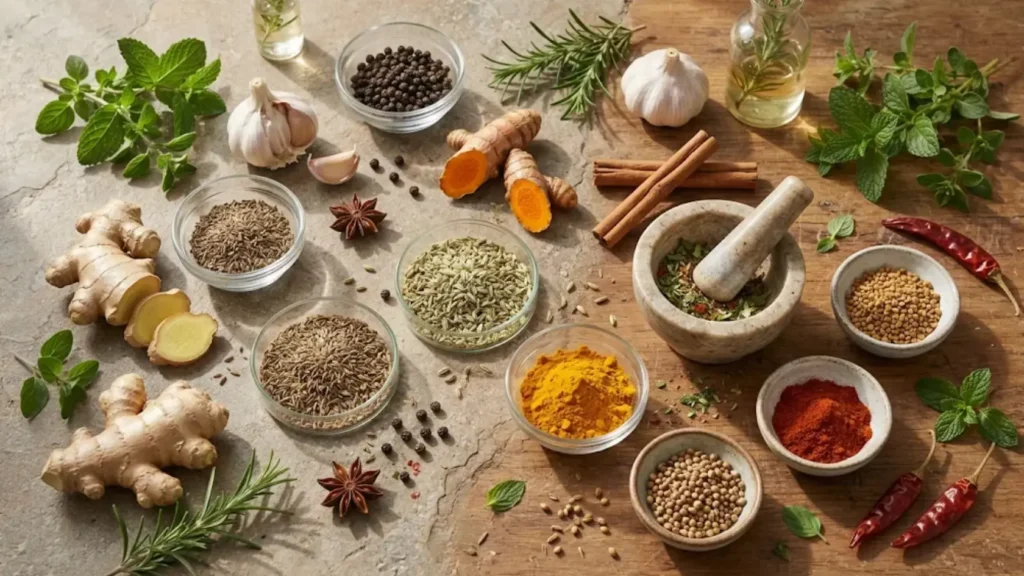
Ready to Bring Global Flavors Home?
Yes. Most culinary spices are gut-friendly in normal amounts. Spices such as black pepper, ginger, turmeric, cumin, garlic and chilli contain polyphenols and fibres that gut bacteria feed on. Human trials show that about 1 to 1.5 teaspoons of mixed herbs and spices a day can increase gut bacterial diversity within 2 to 4 weeks. The main risks come from too much salt and, for sensitive people, very high chilli heat.
Every plate of food in Pakistan starts with masala. Haldi, zeera, kali mirch, lehsan and lal mirch are part of daily cooking, and snack seasonings now add peri peri, jalapeno and lemon chilli flavours to chips, fries and popcorn. So a fair question follows: what do all these seasonings do inside your gut?
This guide explains what the research actually shows, spice by spice. It separates strong evidence from early lab findings, covers who should be careful, and gives practical tips for enjoying bold flavour while keeping your gut happy. It is written by the BioMasdar team, who formulate spice oleoresins and snack seasonings, and it is grounded in peer-reviewed studies listed at the end.
Key Takeaways
- Spices act like mild prebiotics: they shift gut bacteria toward more diverse, healthier communities.
- Garlic is a true prebiotic source (inulin and fructans), but it can trigger bloating in people with IBS.
- Chilli (capsaicin) is helpful at moderate doses and irritating at high doses or with GERD.
- Salt is the seasoning to watch. High salt intake reduced beneficial Lactobacillus in a human pilot study.
- Choose seasonings for flavour, use them in sensible portions, and pair them with fibre-rich foods.
What “Gut Health” Actually Means
Gut health means a digestive system that breaks down food comfortably, absorbs nutrients well and keeps a balanced community of microbes. Three parts matter most when we talk about seasonings.
- The gut microbiome. Trillions of bacteria live in your large intestine. People with a more diverse microbiome tend to have better overall health, and diet is one of the strongest levers that shapes it.
- Short-chain fatty acids (SCFAs). When gut bacteria ferment fibre and plant compounds, they produce SCFAs such as butyrate, acetate and propionate. Butyrate is the main fuel for the cells lining your colon.
- The gut barrier. A single layer of cells separates gut contents from your bloodstream. SCFAs help keep this barrier tight, which limits inflammation.
How Spices Interact with Your Gut Bacteria
Most spice compounds are not fully absorbed in the small intestine. Polyphenols, fibres and pungent compounds travel to the colon, where bacteria break them down. In the process, spices can feed helpful bacteria (a prebiotic effect) and slow down some harmful ones (an antimicrobial effect). This is why spices were used to preserve food long before refrigerators existed.
What Science Says: Two Key Human Studies
Two controlled human trials give the clearest picture of seasonings and the gut microbiome.
UCLA pilot trial (2019). Researchers gave 29 healthy adults a daily 5 g capsule of mixed spices (cinnamon, oregano, ginger, black pepper and cayenne) or a placebo for two weeks. The spice group showed clear changes in gut bacteria, which the authors described as a prebiotic effect at culinary doses. Fecal SCFA levels did not change significantly, so the effect was on bacterial composition rather than measurable fermentation output.
Penn State controlled-feeding trial (2022). Fifty-four adults at risk of heart disease ate the same diet with low, moderate or high amounts of herbs and spices, about 1/8 tsp, 3/4 tsp and 1.5 tsp a day, for four weeks each. The moderate and high doses increased gut bacterial diversity and the Ruminococcaceae family, a group linked to butyrate production.
Both studies are small, and both researchers stress that more work is needed. Still, they point the same way: everyday amounts of spices nudge the microbiome in a healthier direction.
Spice by Spice: How Common Seasonings Affect Your Gut
| Spice | Key compound | What it does in the gut | Evidence strength | Watch out for |
| Chilli (lal mirch, cayenne, jalapeno, habanero) | Capsaicin | Moderate doses raised Faecalibacterium and butyrate in a human feeding trial; activates TRPV1 receptors that speed gut movement | Moderate (human + lab) | Heartburn, burning stools, IBS flare-ups at high doses |
| Black pepper (kali mirch) | Piperine | Stimulates digestive enzymes and bile; boosts absorption of curcumin and other nutrients | Moderate (lab + small human) | Rarely an issue in food amounts |
| Garlic (lehsan) | Inulin, fructans, allicin | True prebiotic fibre that feeds Bifidobacteria; allicin is antimicrobial | Strong for prebiotic fibre | High-FODMAP: bloating and gas in IBS |
| Turmeric (haldi) | Curcumin | Anti-inflammatory; feeds beneficial bacteria in lab fermentation studies | Moderate (lab + animal) | Poorly absorbed alone; pair with black pepper and fat |
| Ginger (adrak) | Gingerols, shogaols | Speeds stomach emptying, eases nausea; shows activity against E. coli in lab tests | Strong for nausea, moderate for microbiome | Mild heartburn in large amounts |
| Cumin (zeera) | Cuminaldehyde | Traditionally used for bloating; supports digestive enzyme activity | Early / traditional | None at culinary doses |
| Coriander (dhania) | Linalool, fibre | Antispasmodic; used for indigestion and gas | Early / traditional | None at culinary doses |
| Cinnamon (darchini) | Cinnamaldehyde, polyphenols | Part of the spice mix that shifted bacteria in the UCLA trial | Moderate (in blends) | Cassia type is high in coumarin; keep amounts modest |
| Lime, lemon, tomato powder | Citric acid, vitamin C, lycopene | Adds tang so you need less salt; polyphenols feed microbes | Indirect benefit | Acidic: can trigger reflux in GERD |
| Cheese and butter flavours | Dairy solids | Mostly flavour; little direct gut effect | Not applicable | Lactose or dairy sensitivity |
Chilli and Capsaicin: Friend or Irritant?
Capsaicin follows a dose-response curve. In a controlled feeding trial in 12 healthy adults, chilli powder providing 5 to 10 mg of capsaicin a day increased Faecalibacterium and butyrate, with the strongest effect in people with a Bacteroides-dominant gut type. Kang et al., JCEM, 2016 A lab model of the human gut also found more microbial diversity and more butyrate after regular capsaicin exposure.
The picture flips at high doses. Animal studies show gut inflammation at very high capsaicin levels, and a 2026 human cohort study linked long-term heavy chilli intake to fewer Lactobacillus and more Klebsiella. Food Research International, 2026 The practical message is simple: enjoy heat at a level your stomach is comfortable with.
Garlic: A Powerful Prebiotic in Your Spice Rack
Garlic contains inulin and fructo-oligosaccharides, fibres that pass undigested to the colon and feed Bifidobacteria. That makes garlic one of the few seasonings with genuine prebiotic fibre. The same fibres are FODMAPs, so people with irritable bowel syndrome (IBS) often bloat after garlic. Garlic-infused oil gives the flavour without most of the fructans.
Turmeric and Black Pepper: A Beneficial Pair
Curcumin, the active compound in turmeric, is poorly absorbed on its own. Piperine in black pepper slows its breakdown and raises absorption substantially. Much of the curcumin you eat still reaches the colon, where gut bacteria convert it into active metabolites. Cooking haldi with kali mirch and a little oil, as desi tadka already does, is the science-backed way to use it.
Ginger, Cumin, and Coriander: The Digestive Trio
Ginger has the best human evidence of the three, mainly for nausea and faster stomach emptying. A lab study of human stool bacteria found ginger, turmeric and long pepper all shifted bacterial communities toward potentially beneficial profiles. Peterson et al., 2019 Cumin and coriander are long used in South Asian cooking for gas and indigestion, though controlled human data is still limited.
The Other Side: When Seasonings Can Upset Your Gut
Spices themselves are rarely the problem. Salt, portion size and personal sensitivity matter more.
Salt: The Seasoning to Watch
A 2017 study in Nature found that a high-salt diet depleted Lactobacillus in mice. In a pilot study in humans, a moderate high-salt challenge also reduced intestinal Lactobacillus, raised inflammatory TH17 immune cells and increased blood pressure. Wilck et al., Nature, 2017 The World Health Organization advises adults to keep salt under 5 g a day, about one level teaspoon, and most people in Pakistan eat well above that.
The good news is that bold spices make food taste satisfying with less salt. Researchers in the Penn State trial pointed to this as one of the biggest practical benefits of cooking with herbs and spices.
Flavor Enhancers and Additives
MSG (monosodium glutamate) is classed as safe by major food regulators, and current evidence does not show it harms the gut microbiome at normal intakes. Some people report sensitivity, and it still adds sodium. Anti-caking agents used in seasonings are approved in small amounts. If you have a specific sensitivity, read the ingredient list.
Who Should Be Careful with Spicy and Tangy Seasonings?
| Condition | What to limit | Why |
| GERD and acid reflux | Very hot chilli, lime, tomato, black pepper in excess | Can relax the lower oesophageal sphincter and irritate the food pipe |
| IBS | Garlic, onion powder, high chilli heat | Fructans ferment and cause gas; capsaicin can trigger abdominal pain |
| Gastritis or peptic ulcer | Strong chilli and acidic flavours | Irritation of an already inflamed stomach lining |
| Haemorrhoids and anal fissures | High chilli heat | Capsaicin is not fully broken down and can cause burning |
| High blood pressure or kidney disease | Salty snack seasonings | Sodium raises blood pressure |
| Young children | Very hot blends | Lower tolerance to capsaicin |
If spicy food regularly causes pain, bleeding, vomiting or weight loss, see a doctor or gastroenterologist rather than adjusting your diet alone.
Snack Seasonings and Your Gut: A Flavor-by-Flavor Guide
Snack seasonings are blends of spices, acids, dairy powders and salt made to coat chips, fries, nuts and popcorn. Their gut impact depends on two things: the spices in the blend and how much you use. At BioMasdar, our seasonings are built on real spice profiles such as chilli, black pepper, garlic, lime and tomato, the same ingredients studied above. Here is how each flavour fits a gut-conscious diet.
| BioMasdar seasoning | Flavour profile | Gut-relevant spices | Best for | Gentle-gut note |
| Peri Peri Seasoning | Smoky, garlicky, medium-hot | Chilli, garlic, paprika, citrus | Fries, grilled chicken, roasted veggies | Moderate heat; skip if garlic bothers you |
| Hot and Spicy Seasoning | Bold, fiery | Chilli, black pepper | Chips, nimko, popcorn | Highest heat; go easy with GERD or IBS |
| Habanero Flavor Seasoning | Fruity, intense heat | Habanero chilli | Wings, nuts, dips | Very hot; start with a light dusting |
| Lemon Chilli Seasoning | Tangy, zesty, spicy | Chilli, citrus | Chips, corn, salads | Acidic; reflux-prone people use less |
| Lime Jalapeno Seasoning | Bright, mild-hot | Jalapeno, lime | Popcorn, wraps, roasted chickpeas | Milder chilli than habanero |
| Lime Tomato Seasoning | Tangy, savoury | Tomato, lime | Kids’ snacks, potato wedges | Low heat; acidic |
| Tomato Jalapeno Seasoning | Sweet-tangy with a kick | Tomato, jalapeno | Nachos, pasta, fries | Moderate heat |
| Cheese Jalapeno Seasoning | Creamy, cheesy, mild-hot | Jalapeno, dairy powder | Nachos, popcorn, puffs | Contains dairy flavour |
| Butter Cheese Seasoning | Rich, mild, buttery | Dairy powders | Popcorn, puffs, kids’ snacks | No chilli heat; good for sensitive stomachs |
| Butter Chicken Seasoning | Creamy, aromatic, desi | Garam masala-style spices, mild chilli | Chips, nuggets, fusion snacks | Mild heat with warming spices |
How to Enjoy Seasoned Snacks the Gut-Friendly Way
- Put seasoning on fibre-rich bases. Roasted chana, air-popped popcorn, makhana, baked sweet potato and roasted vegetables give your gut bacteria fibre to work with alongside the spices.
- Season by taste, not by habit. A light, even coating carries plenty of flavour. More powder mostly adds more salt.
- Match heat to your tolerance. Butter Cheese and Lime Tomato suit sensitive stomachs and children. Hot and Spicy and Habanero are for people who handle chilli well.
- Balance with yoghurt. Raita or plain dahi alongside a spicy snack adds live cultures and cools capsaicin’s burn.
8 Science-Backed Tips for a Gut-Friendly Spice Routine
- Aim for variety. Different spices feed different bacteria. Rotate haldi, zeera, adrak, kali mirch, dhania and chilli through the week.
- Use about 1 to 1.5 teaspoons of mixed spices a day. That is the range linked to higher gut diversity in the Penn State trial, and normal desi cooking often reaches it.
- Pair turmeric with black pepper and fat. This combination improves curcumin absorption.
- Cook garlic gently or use garlic oil if you have IBS. You keep the flavour and cut most of the gas-forming fructans.
- Let spices replace salt. Add lime, chilli, cumin or black pepper first, then taste before adding salt.
- Build heat gradually. Your tolerance to capsaicin increases with regular, moderate exposure.
- Eat spices with fibre. Lentils, whole grains, vegetables and legumes give gut bacteria the main fuel they need to make butyrate.
- Notice your own response. Gut microbiomes differ, and the capsaicin study showed people respond differently by gut type. If a flavour causes discomfort, scale back.
Myths vs. Facts About Spices and Gut Health
| Myth | Fact |
| Spicy food causes stomach ulcers. | Most ulcers are caused by H. pylori infection or painkillers such as NSAIDs. Spicy food can irritate an existing ulcer but does not cause one. |
| Spices kill good gut bacteria. | At culinary doses, spices shifted bacteria toward more diverse, beneficial communities in human trials. |
| All seasonings are unhealthy. | The spices in a seasoning are usually beneficial. Salt content and portion size decide whether a seasoned food is a good choice. |
| Turmeric alone heals the gut. | Turmeric has anti-inflammatory potential, but it is poorly absorbed alone and works as part of an overall diet, not as a cure. |
| If spice burns, it is damaging your gut. | The burn is capsaicin activating pain receptors (TRPV1), not tissue damage. Persistent pain is a reason to see a doctor. |
| Garlic is good for every gut. | Garlic is a strong prebiotic, but its fructans trigger bloating in many people with IBS. |
Let’s Talk About the Details
Q1. Are spices good for your gut?
Yes, in normal cooking amounts. Human trials show that 1 to 1.5 teaspoons of mixed herbs and spices a day can increase gut bacterial diversity and beneficial bacteria such as Ruminococcaceae within four weeks.
Q2. Which spices are best for gut health?
Ginger, turmeric with black pepper, garlic, cumin, cinnamon and moderate chilli have the most supporting evidence. Garlic provides prebiotic fibre, ginger aids digestion, and black pepper improves nutrient absorption.
Q3. Does spicy food damage your stomach?
No, spicy food does not damage a healthy stomach. Capsaicin activates pain receptors without harming tissue. It can, however, worsen symptoms in people with GERD, IBS, gastritis or ulcers.
Q4. Is capsaicin good for the gut microbiome?
At moderate doses, yes. A controlled trial found 5 to 10 mg of capsaicin a day increased butyrate-producing Faecalibacterium. Very high long-term intake has been linked to inflammation and fewer Lactobacillus.
Q5. Can seasonings cause bloating?
Some can. Garlic and onion powders contain fructans that ferment in the gut and cause gas, especially in people with IBS. High-salt seasonings can also cause water retention that feels like bloating.
Q6. Does salt affect gut bacteria?
Yes. A study published in Nature found that a high-salt diet reduced beneficial Lactobacillus in mice and in a human pilot study. Keeping salt under 5 g a day protects both gut and heart health.
Q7. Is black pepper good for digestion?
Yes. Piperine in black pepper stimulates digestive enzymes and bile flow, and it improves absorption of nutrients such as curcumin from turmeric.
Q8. Is turmeric good for gut inflammation?
Turmeric’s curcumin has anti-inflammatory effects in lab and animal studies, and gut bacteria convert it into active compounds. It absorbs poorly alone, so pair it with black pepper and a little fat.
Q9. Are snack seasonings healthy?
Snack seasonings can fit a healthy diet when used in light coatings on fibre-rich bases like popcorn, roasted chana or vegetables. The spices are usually beneficial; the salt content is the part to keep in check.
Q10. How much spice per day is healthy?
About 1 to 1.5 teaspoons of mixed herbs and spices a day is the amount linked to gut benefits in research. Most people can enjoy more, as long as heat and salt stay within personal comfort.
Q11. Can spicy food cause diarrhoea?
Yes, in some people. Capsaicin speeds up gut movement and can cause loose stools or a burning sensation, particularly after very hot meals or in people with IBS.
Q12. Should people with IBS avoid seasonings?
Not all of them. People with IBS often react to garlic, onion and high chilli heat, but cumin, ginger, turmeric, black pepper and herbs are usually well tolerated. A dietitian can guide a low-FODMAP approach.
The Bigger Picture
The science is clear on the big picture. Everyday spices such as chilli, black pepper, garlic, turmeric, ginger and cumin support a more diverse gut microbiome, and controlled human trials have measured that shift at ordinary cooking doses. The real risks sit with excess salt and with very high heat for people who have reflux, IBS or ulcers.
So you do not need to choose between bold flavour and a healthy gut. Use a variety of spices, keep salt in check, match heat to your comfort and pair seasonings with fibre-rich foods. That is how traditional desi cooking has worked for generations, and research is now catching up.
Ready to Add Bold, Balanced Flavor?
Explore the BioMasdar seasoning range, from mild Butter Cheese and tangy Lime Tomato to fiery Habanero Flavor and Hot and Spicy. Whether you are a snack manufacturer looking for consistent, spice-forward profiles or a food business developing new flavours, our team can help you find the right blend. Explore BioMasdar Seasonings → · Talk to Our Flavour Team →