
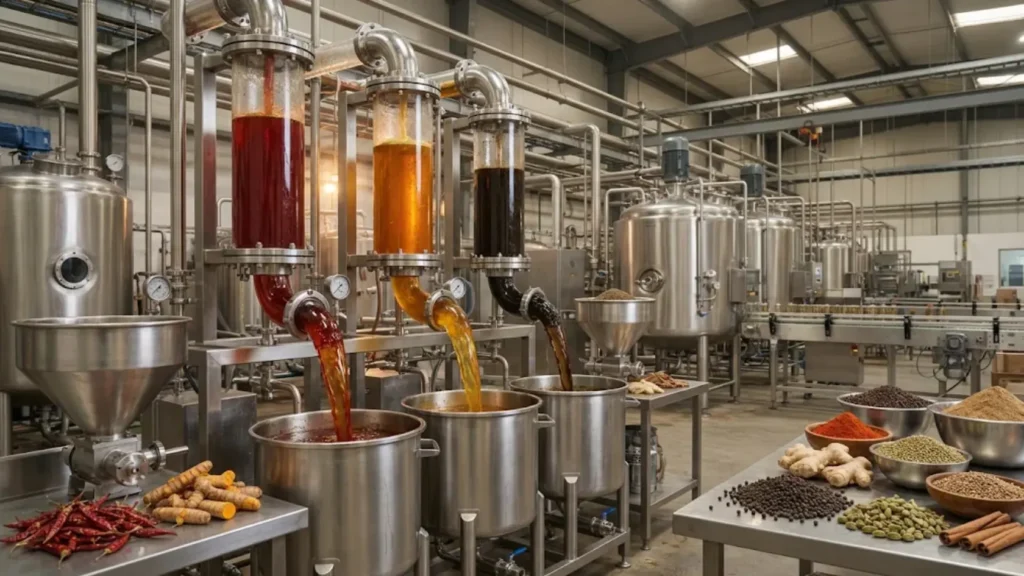
What Are Spice Oleoresins?
Spice oleoresins are concentrated liquid extracts of whole spices that contain both the volatile oil (aroma) and the non-volatile resin (taste, pungency and color). They are made by extracting ground spice with a food-grade solvent or supercritical CO2, then removing the solvent. One kilogram of oleoresin can replace many kilograms of ground spice, which is why food manufacturers use them for consistent flavor, cleaner labels on microbial load, and lower storage costs.
For industrial food processors, the problem with ground spices is simple. Flavor strength changes from crop to crop, powders carry dust and microbes, and large volumes need warehouse space. Oleoresins solve all three by delivering a standardized, measurable flavor in a small, stable liquid.
This guide explains how oleoresins are made, how they compare with ground spices and essential oils, where each type works best, how to dose them, and how to judge quality before you buy. It draws on the five oleoresins BioMasdar produces for food manufacturers: Black Pepper, Capsicum, Cardamom, Garlic and Coriander.
Key facts at a glance
- Definition: a solvent-free spice extract holding volatile oil plus resin.
- Strength: typically 10 to 40 times stronger than the ground spice, depending on the spice and grade.
- Main benefit: standardized flavor, color and heat in every batch.
- Common users: snack seasoning, meat processing, sauces, ready meals, bakery and beverages.
- Shelf life: usually 12 to 24 months when sealed and stored cool and dark.
How Are Spice Oleoresins Made?
Spice oleoresins are made in six steps: raw spice selection, cleaning and drying, grinding, extraction, solvent removal, and standardization. The extraction method decides the final flavor profile, purity and residual solvent level.
- Raw material selection: spices are sourced by origin and tested for moisture, active compounds, pesticide residues and aflatoxins.
- Cleaning and drying: stones, stems and foreign matter are removed, and moisture is brought down to a level that suits extraction.
- Grinding: the spice is ground to a controlled particle size so the solvent can reach the cells evenly.
- Extraction: the ground spice is extracted with a food-grade solvent such as ethanol, acetone or hexane, or with supercritical CO2.
- Solvent removal: the solvent is distilled off under vacuum at low temperature, so heat-sensitive aroma compounds survive.
- Standardization and blending: the extract is tested and adjusted to a fixed strength, for example a set piperine percentage or Scoville heat level, then filled and sealed.
Solvent Extraction vs. Supercritical CO₂ Extraction
| Factor | Solvent extraction | Supercritical CO2 extraction |
| Solvent | Ethanol, acetone, hexane, ethyl acetate | Pressurized carbon dioxide |
| Residual solvent | Very low, controlled to regulatory limits | None, CO2 evaporates fully |
| Flavor profile | Full, includes resins and color | Very close to fresh spice aroma |
| Cost | Lower | Higher |
| Best for | High-volume seasoning, color and heat | Premium and clean-label products |
Many processors also order oleoresins in a ready-to-use form. Common formats are dispersed on salt, dextrose or maltodextrin, emulsified for water-based systems, or encapsulated for heat and oxidation stability.
Oleoresins vs Ground Spices vs Essential Oils
Oleoresins give the full taste of a spice in a standardized, low-microbe form; ground spices give texture and visual specks; essential oils give aroma only. Most large processors use oleoresins as the flavor base and add a small amount of ground spice for appearance.
| Feature | Spice oleoresin | Ground spice | Essential oil |
| What it contains | Volatile oil + resin, pungency, color | Whole spice incl. fiber and starch | Volatile oil only |
| Flavor profile | Complete taste and aroma | Complete, but varies by batch | Aroma only, no heat or body |
| Strength | High, standardized | Low, variable | Very high, aroma only |
| Batch consistency | Excellent | Poor to fair | Good |
| Microbial load | Practically nil | Can be high, may need treatment | Practically nil |
| Storage space | Small | Large | Very small |
| Shelf life | 12 to 24 months | 6 to 12 months before flavor fades | 24 months or more |
| Visual specks | No | Yes | No |
| Typical use | Seasonings, meat, sauces, snacks | Retail packs, visible garnish | Beverages, confectionery aroma |
When Should You Switch from Ground Spices to Oleoresins?
Switch when you need the same taste in every batch, when microbial counts in powders cause QC failures, when you run high volumes and storage costs matter, or when you need flavor without specks in clear sauces, brines and beverages.
The 5 Key Spice Oleoresins and Their Industrial Uses
The five most widely used savory oleoresins are black pepper, capsicum, cardamom, garlic and coriander. Each is standardized on a different marker compound, so you buy it by strength, not just by weight.
| Oleoresin | Key marker compound | Flavor and function | Appearance | Best applications |
| Black Pepper Oleoresin | Piperine (pungency) + volatile oil | Sharp heat, woody, citrusy aroma | Dark green to black viscous liquid | Sausages, burgers, snack seasoning, soups, sauces |
| Capsicum Oleoresin | Capsaicinoids, measured in SHU | Clean, controllable chilli heat | Deep red to red-brown liquid | Hot sauces, chips, instant noodles, marinades, meat |
| Cardamom Oleoresin | Volatile oil (1,8-cineole, alpha-terpinyl acetate) | Warm, sweet, camphor-fresh aroma | Olive-green to brown liquid | Tea premixes, dairy, bakery, desserts, beverages |
| Garlic Oleoresin | Sulfur compounds (allyl sulfides) | Strong savory garlic note, no specks | Amber to golden liquid | Ready meals, dressings, meat, snack seasoning, sauces |
| Coriander Oleoresin | Volatile oil (linalool) | Citrusy, floral, mild spice | Amber to brown liquid | Curry blends, processed meat, pickles, bakery |
Black Pepper Oleoresin
Black pepper oleoresin carries both the bite of piperine and the fresh top notes of pepper oil. Grades are usually sold by piperine content and volatile oil content. It is the most common oleoresin in meat processing because it gives even heat without black specks in light-colored products.
Capsicum Oleoresin
Capsicum oleoresin delivers measurable heat in Scoville Heat Units (SHU). Because heat is standardized, a chips or noodle maker can hit the same spice level every run, even when chilli crops vary. Note that capsicum oleoresin is used for heat, while paprika oleoresin is used mainly for red color.
Cardamom Oleoresin
Cardamom oleoresin is one of the most expensive spices by weight, so its oleoresin offers major cost and handling savings. It gives a smooth, sweet aroma in tea, milk drinks, sweets and baked goods, without the gritty husk of ground pods.
Garlic Oleoresin
Garlic oleoresin gives the savory depth of garlic with none of the peeling, odor handling or short shelf life of fresh cloves. It blends easily into oil-based sauces, marinades and seasoning bases.
Coriander Oleoresin
Coriander seed oleoresin adds a fresh, citrus-floral note that rounds out meat and curry flavors. It is a quiet but essential partner to pepper, chilli and cumin in savory blends.
All five are part of the BioMasdar oleoresin range, supplied to the strength and format that fits each production line.
Industrial Applications by Food Category
Spice oleoresins are used wherever a manufacturer needs the same flavor, heat or aroma at scale: snacks, meat, sauces, ready meals, bakery, dairy and beverages. The right format depends on whether the product is oil-based, water-based or dry.
| Food category | Common oleoresins | Recommended format | Why processors use them |
| Snack seasonings (chips, extruded snacks, nuts) | Capsicum, black pepper, garlic | Plated on salt or maltodextrin | Even coating, exact heat level, no clumping |
| Processed meat and poultry (sausages, nuggets, kebabs) | Black pepper, coriander, garlic, capsicum | Dispersed on dextrose or salt, or in brine | Low microbial load, no specks, uniform taste |
| Sauces, ketchups and dressings | Capsicum, garlic, black pepper | Liquid or emulsified | Blends evenly, clear appearance |
| Instant noodles and soup bases | Capsicum, black pepper, garlic, coriander | Dry-plated or in seasoning oil | Strong flavor in small sachets |
| Ready meals and curry pastes | Coriander, capsicum, garlic, cardamom | Liquid in oil phase | Consistent recipes across large batches |
| Bakery and confectionery | Cardamom, black pepper | Encapsulated or emulsified | Heat-stable aroma, no grit |
| Dairy and tea premixes | Cardamom | Emulsified or on sugar carrier | Smooth aroma in milk and tea |
| Pickles and brines | Capsicum, garlic, coriander | Emulsified, water-dispersible | Flavor without cloudy sediment |
Outside food, the same oleoresins also serve nutraceuticals, flavor houses and animal feed. This guide focuses on food processing, where consistency and food safety matter most.
How to Use Spice Oleoresins: Dosage and Conversion
To replace ground spice with oleoresin, divide the ground spice quantity by the oleoresin’s replacement ratio, then fine-tune with a sensory trial. The replacement ratio, also called fold strength, comes from the supplier’s specification sheet.
- Oleoresin needed = Ground spice in recipe\Replacement ratio
Worked example: a sausage recipe uses 2 kg of ground black pepper per batch. If the oleoresin grade has a replacement ratio of 1:20, you need 2 ÷ 20 = 0.1 kg (100 g) of oleoresin. Run a small trial and adjust by 5 to 10 percent for taste.
Best Practices for Adding Oleoresins
- Never add pure oleoresin directly to a large batch. It is thick and concentrated, so it creates hot spots.
- Pre-disperse it first. Mix it into oil, salt, dextrose, maltodextrin or a seasoning base before adding to the main mix.
- Warm viscous grades gently. Black pepper and capsicum oleoresins pour better at 40 to 50 °C; avoid direct high heat.
- Match the format to the product. Use oil-soluble grades for fat-based systems and emulsified grades for water-based systems.
- Add aroma-sensitive oleoresins late. Cardamom and coriander lose top notes in long, hot cooking.
- Handle capsicum with care. Wear gloves and eye protection, as high-SHU grades irritate skin and eyes.
- Record every trial. Note batch number, dose and sensory score so production can repeat the result.
A good supplier, such as BioMasdar, will share the replacement ratio and suggested dose range for each grade, and can support lab trials before scale-up.
Quality Specifications and Supplier Checklist
A food-grade oleoresin should come with a Certificate of Analysis (COA) for every batch that confirms strength, residual solvents, heavy metals, microbiology and contaminants. Never buy on price per kilogram alone; compare price per unit of active strength.
| Parameter | What it tells you | How it is checked |
| Marker strength (piperine %, SHU, volatile oil %) | True flavor or heat strength | HPLC, GC, steam distillation |
| Residual solvents | Safety and regulatory compliance | Headspace GC |
| Heavy metals (lead, arsenic, cadmium, mercury) | Contaminant safety | ICP-MS or AAS |
| Aflatoxins and ochratoxin A | Mycotoxin safety, critical for chilli and pepper | HPLC or ELISA |
| Pesticide residues | Compliance with export market limits | LC-MS/MS, GC-MS/MS |
| Microbiology (TPC, yeast, mold, E. coli, Salmonella) | Hygiene of the finished extract | Standard plate methods |
| Color value, refractive index, specific gravity | Identity and batch consistency | Spectrophotometer, refractometer |
| Sudan and synthetic dyes (chilli products) | Freedom from adulteration | HPLC |
10-Point Supplier Checklist
- Batch-wise COA with marker strength stated
- Food safety certification such as ISO 22000, FSSC 22000 or HACCP
- Halal and Kosher certificates if your market needs them
- Residual solvent results within your target market’s limits
- Clear replacement ratio and suggested dose
- Traceability back to raw spice lot and origin
- Allergen, GMO and irradiation status statements
- Stable supply and lead time for your annual volume
- Samples and technical support for application trials
- Choice of formats: liquid, dispersed, emulsified or encapsulated
Storage, Handling, Safety and Regulation
Store spice oleoresins in sealed, full containers in a cool, dry, dark place, ideally below 25 °C, to keep them stable for 12 to 24 months. Heat, light and air are the three main causes of flavor loss and color fading.
Storage and Handling Tips
- Keep containers tightly closed and minimize headspace to limit oxidation.
- Use food-grade HDPE drums, lacquered tins or amber glass for samples.
- Stir or homogenize before use, as some grades settle or separate over time.
- Follow first-expired, first-out (FEFO) rotation.
- Keep high-SHU capsicum oleoresin labeled and away from other ingredients to avoid cross-contact.
Are Spice Oleoresins Safe to Eat?
Yes. Spice oleoresins used at normal food levels are considered safe. In the United States, solvent-free spice oleoresins are recognized as Generally Recognized as Safe (GRAS) under 21 CFR 182.20. Residual extraction solvents are tightly limited, for example under 21 CFR Part 173 in the US and Directive 2009/32/EC in the EU.
Labeling
Labeling rules differ by country. In many markets, oleoresins can be declared as “spice extract” or “natural flavoring,” while some regulators ask for the specific spice name. Always confirm the wording against your own market’s food authority, such as the Pakistan Food Authorities, SFDA in Saudi Arabia, FDA in the US or EFSA guidance in the EU.
Everything Worth Knowing
Q1. What is a spice oleoresin?
A spice oleoresin is a concentrated liquid extract of a spice that contains both its volatile oil and its non-volatile resin. It delivers the full aroma, taste, pungency and color of the spice in a standardized form.
Q2. What is the difference between an oleoresin and an essential oil?
An essential oil holds only the volatile aroma compounds of a spice. An oleoresin holds the aroma plus the heavier compounds that give taste, heat and color, so it tastes much closer to the whole spice.
Q3. How much ground spice does 1 kg of oleoresin replace?
It depends on the spice and grade. Most spice oleoresins replace roughly 10 to 40 kg of ground spice per kilogram. Always use the replacement ratio on your supplier’s specification sheet.
Q4. Are spice oleoresins natural?
Yes. Oleoresins are extracted directly from real spices, and the solvent is removed after extraction. In many markets they can be labeled as spice extract or natural flavoring.
Q5. What is the shelf life of spice oleoresins?
Spice oleoresins usually last 12 to 24 months in sealed containers stored in a cool, dry and dark place. Exposure to heat, light and air shortens shelf life.
Q6. Which industries use spice oleoresins?
Snack, meat and poultry, sauce, instant noodle, ready meal, bakery, dairy and beverage manufacturers use them most. Flavor houses, nutraceutical companies and feed producers also use them.
Q7. Why do food manufacturers prefer oleoresins over ground spices?
Oleoresins give the same strength in every batch, have practically no microbial load, need far less storage space, and add flavor without visible specks. This lowers rejection rates and simplifies quality control.
Q8. What is capsicum oleoresin used for?
Capsicum oleoresin adds standardized chilli heat, measured in Scoville Heat Units, to hot sauces, chips, instant noodles, marinades and processed meat.
Q9. How do you add oleoresin to a food product?
Pre-disperse it in oil, salt, dextrose or maltodextrin, or use an emulsified grade for water-based foods. Then mix the pre-blend into the main batch to avoid hot spots.
Q10. Are spice oleoresins Halal?
Spice oleoresins are plant-based, but Halal status depends on the extraction solvent, carriers and processing. Buy from a supplier that holds a valid Halal certificate for the specific product.
The Way Forward
Spice oleoresins are the most reliable way to deliver consistent spice flavor at industrial scale. They replace bulky, variable ground spices with a small, standardized and low-microbe liquid that fits snacks, meat, sauces, ready meals, bakery and beverages.
To get the most from them, choose the right spice and strength, match the format to your product, pre-disperse before mixing, and insist on a full COA with every batch. Done well, the switch cuts storage costs, reduces QC failures and gives your customers the same taste every time.
Ready to Upgrade Your Flavor Consistency?
BioMasdar supplies Black Pepper, Capsicum, Cardamom, Garlic and Coriander Oleoresins for food manufacturers who need dependable strength in every batch. Request a free sample and specification sheet today, and our technical team will help you find the right grade and dose for your product.