
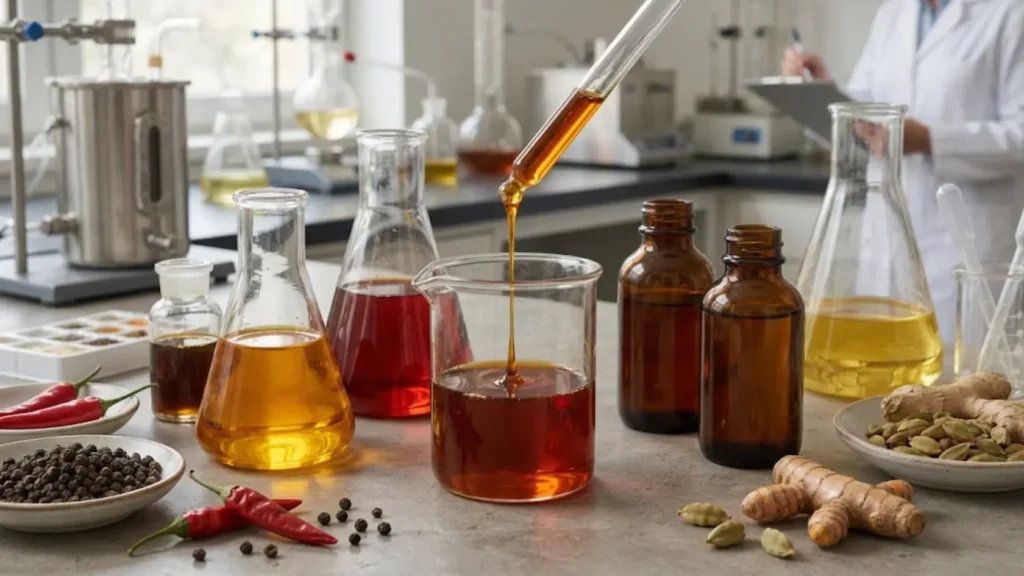
To choose an oleoresin supplier, verify raw material traceability, standardised active compounds, safe extraction with low residual solvents, recognised food safety certifications, batch-wise Certificates of Analysis, contaminant testing, product range, technical support, packaging and supply reliability, and the true cost per unit of flavour delivered, not just price per kg.
The 10 Factors at a Glance:
- Raw material sourcing and traceability
- Standardisation of active compounds (piperine, capsaicin, volatile oil, colour)
- Extraction method and residual solvent limits
- Food safety certifications (ISO 22000, FSSC 22000, HACCP, Halal, Kosher)
- Certificate of Analysis and batch-to-batch consistency
- Contaminant control and regulatory compliance
- Product range, customisation and formats
- Technical and application support
- Packaging, shelf life and supply reliability
- Total cost of ownership, not price per kg
Why Your Oleoresin Supplier Matters
Your oleoresin supplier decides how your product tastes, how safe it is and whether it passes an export audit. An oleoresin is a concentrated spice extract that holds both the essential oil (aroma) and the resin (taste, pungency and colour) of a spice.
Because oleoresins are many times stronger than ground spice, small differences between suppliers get magnified. A 10% drop in piperine or capsaicin strength changes the heat of every batch of seasoning, sauce or snack you make. A residual solvent or aflatoxin result above your market’s limit can stop a whole shipment.
That is why procurement and R&D teams evaluate suppliers on far more than price. This guide covers the 10 factors that matter most, the red flags to avoid and the questions to ask before you sign a contract.
BioMasdar manufactures five spice oleoresins for food and flavour manufacturers: Black Pepper Oleoresin, Capsicum Oleoresin, Cardamom Oleoresin, Garlic Oleoresin and Coriander Oleoresin. The checklist below is the same one we encourage buyers to apply to us.
1. Raw Material Sourcing and Traceability
A good oleoresin starts with good spice. The supplier should know where every lot of pepper, chilli, cardamom, garlic or coriander came from, and be able to prove it.
Origin, harvest season, drying method and storage all affect the active compounds in the spice. Poorly dried or badly stored spice is also the main source of mould and aflatoxin problems later.
What to check:
- A documented supplier approval process for spice growers and traders
- Incoming raw material testing (moisture, volatile oil, foreign matter, mycotoxins)
- Lot-level traceability from finished drum back to raw material batch
- A mock recall result that shows traceability actually works
2. Standardization of Active Compounds
Standardisation means each batch is adjusted to a fixed strength of the compound that delivers flavour, heat or colour. It is the single biggest reason oleoresins outperform ground spice, so confirm how the supplier does it.
Ask which marker is specified for each product and which test method is used. Typical markers include:
| Oleoresin | Key quality markers | Common test methods |
| Black Pepper Oleoresin | Piperine %, volatile oil (ml/100 g) | UV spectrophotometry or HPLC (piperine), Clevenger distillation (volatile oil) |
| Capsicum Oleoresin | Pungency in Scoville Heat Units (SHU) or capsaicinoids %, colour value | HPLC (capsaicinoids), ASTA colour method |
| Cardamom Oleoresin | Volatile oil %, 1,8-cineole and alpha-terpinyl acetate profile | Clevenger distillation, GC |
| Garlic Oleoresin | Volatile oil / allyl sulphide content | Distillation, GC |
| Coriander Oleoresin | Volatile oil %, linalool content | Clevenger distillation, GC |
A reliable supplier states each specification as a range (for example, piperine 40-45%) and holds every batch inside it. HPLC results are more specific than UV results, so ask which one the COA figure comes from.
3. Extraction Methods and Residual Solvent Limits
The extraction method controls flavour fidelity and how much solvent is left in the product. Ask the supplier exactly which method and solvents they use, and how they remove them.
- Solvent extraction with food-grade ethanol, acetone, ethyl acetate or hexane is the most common route. The solvent is then removed under vacuum.
- Supercritical CO2 extraction leaves no solvent residue and keeps delicate aroma notes, but usually costs more.
Residual solvent limits are set by regulators and international standards such as JECFA specifications and, for Europe, Directive 2009/32/EC. Ask for headspace gas chromatography (GC-HS) results for each solvent used, checked against the limits of every market you sell into.
4. Food Safety Certifications
Certifications show that a third party has audited the supplier’s food safety system, not just the product. They are often a precondition for selling to large food brands and exporters.
| Certification | What it proves | Who usually asks for it |
| HACCP | Hazards are identified and controlled at critical points | All food buyers |
| ISO 22000 | A complete food safety management system | Mid to large manufacturers |
| FSSC 22000 or BRCGS | GFSI-benchmarked food safety | Multinationals, retailers, exporters |
| Halal | Ingredients and solvents meet Halal requirements | Pakistan, GCC, Southeast Asia, Muslim-majority markets |
| Kosher | Meets Kosher requirements | US and EU buyers |
| ISO/IEC 17025 (lab) | The in-house or partner lab is accredited | Buyers who rely on supplier COAs |
Do not accept a logo on a website as proof. Ask for the current certificate, check the scope covers oleoresin production at that site, and confirm the expiry date.
5. Certificate of Analysis and Batch-to-Batch Consistency
A Certificate of Analysis (COA) should travel with every batch, and the numbers on it should match your agreed specification. Consistency across batches matters more than one excellent sample.
A complete oleoresin COA usually includes:
- Batch number, manufacturing date and best-before date
- Active marker results (piperine, capsaicinoids, volatile oil or colour value)
- Physical properties: appearance, colour, specific gravity, refractive index, solubility
- Residual solvents
- Microbiology: total plate count, yeast and mould, coliforms, E. coli, Salmonella
- Test methods used and the lab that ran them
Ask for COAs from three to five recent batches of the same product. If results swing widely, expect your finished product to swing too. For critical ingredients, verify a sample at an independent accredited lab before approval.
6. Contaminant Control and Regulatory Compliance
Spices are a high-risk category for contaminants, and those risks concentrate in an extract. A strong supplier tests for them routinely and knows the limits in your target markets.
Ask for recent test reports covering:
- Mycotoxins: aflatoxins B1 and total, and ochratoxin A (especially for capsicum and pepper)
- Pesticide residues: a multi-residue screen against EU, Codex or destination-country MRLs
- Heavy metals: lead, arsenic, cadmium and mercury
- Illegal dyes: Sudan dyes and similar, especially for red capsicum products
- Allergen and GMO status statements
Also confirm the supplier can provide the documents your market expects. These include product specifications, safety data sheets, allergen declarations, country of origin, and food contact compliance for packaging.
7. Product Range, Customization, and Formats
A supplier with a broad, relevant range lets you consolidate purchasing, simplify audits and build blends from one source. Check that the range matches the flavour profiles you actually use.
Pure oleoresins are thick and oil-soluble, which suits some applications but not all. Ask whether the supplier can offer:
- Custom strengths, such as a specific SHU level or piperine percentage
- Water-soluble or water-dispersible versions for beverages, brines and sauces
- Plated or spray-dried powders for dry seasonings and snack coatings
- Custom blends that combine several oleoresins into one ingredient
- Minimum order quantities that fit trial runs as well as full production
8. Technical and Application Support
The best oleoresin suppliers act as a technical partner, not just a seller. Good support shortens your development time and reduces costly trial-and-error.
Look for a supplier who can:
- Recommend dosage, for example how much oleoresin replaces 1 kg of ground spice
- Advise on dispersion, heat stability and interaction with other ingredients
- Supply samples quickly with matching COAs
- Help troubleshoot issues such as separation, colour fade or flavour loss
- Respond to quality complaints with a root-cause analysis and a corrective action plan
9. Packaging, Shelf Life, and Supply Reliability
Oleoresins lose aroma when exposed to heat, light and air, so packaging and storage directly affect quality on arrival. Supply reliability decides whether your production line keeps running.
Packaging and Shelf Life:
- Food-grade HDPE drums, lined tins or aluminium containers, ideally nitrogen-flushed
- Clear labels with batch number, net weight and storage instructions
- A stated shelf life (commonly 12 to 24 months in sealed original containers) with stability data behind it
- Storage guidance: cool, dry, away from direct light, and how to re-homogenise if the product separates
Supply Reliability:
- Production capacity versus your annual volume, including peak season
- Typical lead times and whether safety stock can be held for you
- Raw material contracts that protect against crop failures and price spikes
- Export documentation and experience shipping to your country
10. Total Cost of Ownership, Not Just Price per kg
The cheapest oleoresin per kg is often the most expensive per batch of finished product. Compare suppliers on the cost of the flavour, heat or colour actually delivered.
A practical way to compare is cost per unit of active compound:
- Cost per unit of active = Price per kg\Active content (%)
For example, a pepper oleoresin at 45% piperine can work out cheaper than one at 35% piperine sold for 15% less per kg. Add the hidden costs of a weak supplier too: rejected batches, extra testing, reformulation, production downtime and recall risk.
Oleoresin Supplier Evaluation Scorecard
Score each shortlisted supplier from 1 (weak) to 5 (strong) on every factor, multiply by the weight, and compare totals. Adjust the weights to your own risk profile; the ones below suit most food manufacturers.
| Factor | Weight | Evidence to request | Supplier A (1-5) | Supplier B (1-5) |
| Standardisation of active compounds | 15% | Specs with ranges, test methods, 3-5 batch COAs | 5 | 3 |
| Contaminant control and compliance | 15% | Mycotoxin, pesticide, heavy metal and dye reports | 5 | 2 |
| Food safety certifications | 12% | Current certificates with scope and expiry | 4 | 3 |
| Extraction and residual solvents | 10% | Process description, GC-HS solvent results | 4 | 3 |
| COA and batch consistency | 10% | Batch COAs, independent lab check | 5 | 2 |
| Raw material sourcing and traceability | 10% | Supplier approval process, mock recall | 4 | 3 |
| Supply reliability and packaging | 10% | Capacity, lead times, packaging specs, shelf-life data | 4 | 3 |
| Total cost of ownership | 8% | Price, active content, MOQ, payment terms | 3 | 5 |
| Technical and application support | 5% | Dosage guidance, sample turnaround, complaint process | 5 | 2 |
| Range, customisation and formats | 5% | Product list, custom strength and format options | 4 | 3 |
| Weighted total | 100% | 4.37 / 5 | 2.86 / 5 |
Red Flags to Avoid
Walk away, or dig much deeper, if a supplier shows any of these signs:
- Specifications given as a single number with no range or test method
- COAs that look identical across batches, or are missing dates and lab details
- No residual solvent or mycotoxin data, or reluctance to share it
- Certificates that are expired, issued for another site or not verifiable with the certifying body
- Prices far below the market for the stated active content
- Samples that perform much better than the first commercial delivery
- No clear answer on raw material origin or extraction solvent
- Slow or defensive responses to quality complaints
How to Qualify an Oleoresin Supplier: Step by Step
- Define your specification: product, active marker range, format, solubility, packaging and target markets.
- Send a request for quotation (RFQ) with that specification and a document checklist.
- Review documents: certificates, specs, batch COAs, contaminant and solvent reports.
- Test samples in your own application, alongside your current ingredient, and verify one sample at an independent lab.
- Audit the supplier, on site or remotely, or review a recent third-party audit report.
- Run a pilot order and compare the commercial batch with the approved sample.
- Approve and monitor: agree specifications in writing, then review COAs, complaints and delivery performance at least once a year.
Ten questions to ask every oleoresin supplier:
- Where do you source your raw spices, and can you trace a batch back to its lot?
- Which active marker do you standardise, to what range, and by which method?
- Which extraction solvents do you use, and what are your residual solvent results?
- Which food safety, Halal and Kosher certificates do you hold, and for which site?
- Can you share COAs from your last five batches of this product?
- How often do you test for aflatoxins, ochratoxin A, pesticides, heavy metals and illegal dyes?
- Can you customise strength, solubility or format for my application?
- What dosage do you recommend to replace my current spice or extract?
- What are your capacity, lead times, MOQ and packaging options?
- How do you handle a quality complaint, and how fast do you respond?
BioMasdar Spice Oleoresins and Their Applications
BioMasdar offers five spice oleoresins for food, seasoning and flavour manufacturers. Each one can be assessed against the 10 factors above.
| BioMasdar product | Flavour contribution | Typical applications |
| Black Pepper Oleoresin | Pungency and warm, peppery aroma | Seasonings, processed meats, sauces, snacks, soups |
| Capsicum Oleoresin | Controlled heat (pungency) | Chilli sauces, snack seasonings, marinades, ready meals |
| Cardamom Oleoresin | Sweet, floral, cooling aroma | Bakery, confectionery, dairy, tea and beverage blends |
| Garlic Oleoresin | Savoury, pungent garlic notes | Meat products, dressings, sauces, savoury snacks |
| Coriander Oleoresin | Citrusy, slightly sweet spice note | Curry blends, pickles, meat products, savoury seasonings |
Ask BioMasdar for product specifications, recent batch COAs and samples to run through your own supplier evaluation.
Let’s Explore Your Questions
Q1. What should I look for in an oleoresin supplier?
Look for traceable raw materials, standardised active compounds, low residual solvents, recognised food safety certifications, batch-wise COAs, routine contaminant testing, technical support and reliable supply. Judge price by cost per unit of active compound, not price per kg.
Q2. How is oleoresin quality measured?
Oleoresin quality is measured by its active markers and safety tests. Markers include piperine for black pepper, capsaicinoids or Scoville Heat Units for capsicum, and volatile oil content for cardamom, garlic and coriander. Safety tests cover residual solvents, mycotoxins, pesticides, heavy metals and microbes.
Q3. What certifications should an oleoresin supplier have?
At minimum, a supplier should have HACCP. Larger buyers usually require ISO 22000, FSSC 22000 or BRCGS. Halal and Kosher certificates are needed for many markets, and an ISO/IEC 17025 accredited lab adds confidence in COA results.
Q4. What is a Certificate of Analysis for oleoresins?
A Certificate of Analysis (COA) is a batch-specific test report. It lists the batch number, dates, active marker results, physical properties, residual solvents and microbiology, along with the test methods used.
Q5. Why do residual solvents matter in oleoresins?
Solvents such as acetone, hexane or ethanol are used to extract oleoresins and must be removed afterwards. Regulators set maximum residue limits, so results above them can make a product unsafe or unsellable in that market.
Q6. Is supercritical CO2 extraction better than solvent extraction?
Supercritical CO2 extraction leaves no solvent residue and preserves delicate aromas, but it usually costs more. Well-controlled solvent extraction is safe and widely used when residual solvents stay within legal limits.
Q7. How long do oleoresins last?
Most spice oleoresins have a shelf life of about 12 to 24 months in sealed original containers stored cool, dry and away from light. Always follow the best-before date and storage instructions on the supplier’s COA and label.
Q8. How much oleoresin replaces ground spice?
It depends on the spice and the oleoresin’s strength. Because oleoresins are highly concentrated, a small amount replaces a much larger quantity of ground spice. Ask the supplier for a replacement ratio based on the batch’s active content, then confirm it in your own trials.
Q9. Why are some oleoresins cheaper than others?
Lower prices often reflect a lower active content, weaker raw material, less testing or fewer certifications. Compare suppliers on cost per unit of active compound and on the risk of rejected batches.
Q10. Can an oleoresin supplier customise products?
Many suppliers can adjust strength, create blends and offer water-soluble or powdered formats. Share your application, target flavour level and processing conditions so the supplier can recommend the right option.
Bringing It All Together
The right oleoresin supplier gives you the same flavour, heat and safety profile in every batch. Evaluate traceability, standardisation, extraction, certifications, COAs, contaminant control, range, technical support, supply reliability and true cost before you sign.
Use the scorecard and the ten questions above to compare suppliers on evidence, not promises. A supplier that welcomes this scrutiny is usually the one worth working with.
Ready to evaluate BioMasdar?
BioMasdar supplies Black Pepper, Capsicum, Cardamom, Garlic and Coriander Oleoresins to food and flavour manufacturers. Request product specifications, batch COAs and samples, and put our oleoresins through your own supplier evaluation. Request a sample and specification sheet.