
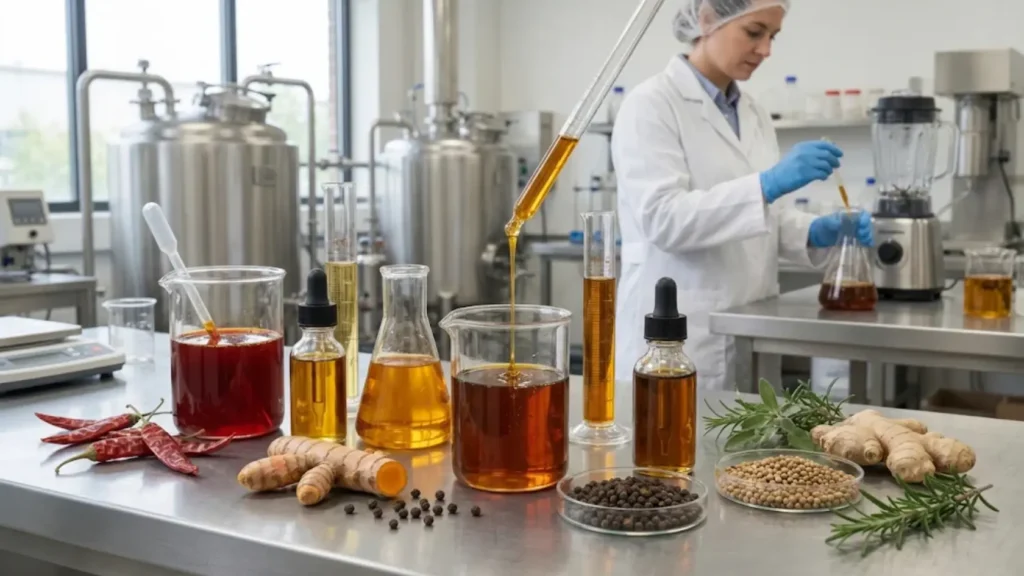
Food manufacturers achieve consistent flavor profiles with oleoresins by replacing raw spices with concentrated extracts standardized to a fixed level of their key flavor compounds, such as piperine in black pepper or capsaicin in chilli. Because every batch of oleoresin is tested and adjusted to the same specification, a manufacturer can add the same weight to every production run and get the same taste, aroma, color and heat, regardless of crop season, origin or harvest quality.
A customer who buys your chips, sauce or spice mix expects it to taste exactly like the last pack. Raw spices make that promise hard to keep, because their strength changes from one harvest to the next. Oleoresins solve this at the source.
This guide explains what oleoresins are, why ground spices drift, how standardization works, how to dose and disperse oleoresins correctly, and what to check before choosing a supplier. It is written for R&D, quality and procurement teams in snacks, seasonings, meat processing, sauces, bakery and ready meals.
Key Takeaways
- Oleoresins capture both the volatile aroma oils and the non-volatile pungent and color compounds of a spice.
- Each lot is standardized to a measurable value (piperine %, SHU, ASTA color, volatile oil %), so flavor stays the same batch after batch.
- A small dose of oleoresin replaces many times its weight in ground spice, which cuts storage, cost and contamination risk.
- Good results depend on correct dispersion, usually by plating on a carrier like salt or maltodextrin, or by emulsifying into oil or water.
- Always request a Certificate of Analysis (COA) for every lot.
What Are Oleoresins?
An oleoresin is a concentrated, liquid or semi-solid extract of a spice that contains its full flavor profile: the volatile essential oil that gives aroma, plus the non-volatile resins that carry pungency, color and body. In simple terms, it is the “whole taste” of the spice in a few drops.
This is what separates an oleoresin from an essential oil. An essential oil only captures the aroma. Black pepper essential oil smells like pepper but has almost no bite, because piperine, the compound that makes pepper hot, does not distil with steam. Black pepper oleoresin captures both.
How Oleoresins Are Made
- Cleaning and grinding. Dried spices are cleaned, graded and ground to a set particle size so extraction is even.
- Extraction. The ground spice is extracted with a food-grade solvent such as ethanol, acetone or hexane, or with supercritical carbon dioxide (CO2), which leaves no solvent residue.
- Solvent recovery. The solvent is evaporated under vacuum at low temperature to protect heat-sensitive aroma compounds.
- Blending back the volatile oil. In many cases the essential oil is steam-distilled first and blended back in, so the final product has the right aroma-to-pungency balance.
- Standardization. Each lot is tested and adjusted to a fixed specification, then packed in light-proof containers.
Residual solvents are tightly regulated. For example, US federal rules cap acetone residue in spice oleoresins at 30 parts per million, and similar limits apply to hexane and other extraction solvents. A reliable supplier states residual solvent levels on the COA for every lot.
Why Ground Spices Cause Flavor Inconsistency
Ground spices are agricultural products, so their flavor strength changes with every harvest, origin, storage period and grind. Two bags of black pepper with the same label can differ noticeably in pungency and aroma, and a recipe that uses a fixed weight will taste different from batch to batch.
The main causes of variation are:
- Crop and origin. Piperine in black pepper, capsaicin in chilli and essential oil in cardamom vary by variety, region, rainfall and maturity at harvest.
- Storage losses. Once ground, spices lose volatile aroma oils quickly through evaporation and oxidation. A spice that sat in a warehouse for six months is weaker than a fresh lot.
- Color fading. Red pigments in chilli and paprika fade with light, heat and air, so finished products look different.
- Uneven distribution. Spice particles do not spread evenly in a large mixer, which creates “hot spots” and specks in sauces, meat and dough.
- Microbial load. Raw spices can carry bacteria, yeast and mould, and sterilizing them with heat or steam can further reduce flavor.
- Adulteration risk. Ground spices can be bulked with fillers or low-grade material that is hard to detect by eye.
For a manufacturer, every one of these means rework, customer complaints and wasted quality-control time. Oleoresins remove most of these variables before the ingredient reaches the factory.
How Oleoresins Deliver Consistent Flavor Profiles
Oleoresins create consistency in five ways: they are standardized to a measured strength, dosed precisely, dispersed evenly, microbiologically clean and stable in storage. Together these turn flavor from a variable into a controlled specification.
1. Standardization to a Measurable Marker
Every oleoresin lot is tested for the compound that defines its flavor, then adjusted to the same target. Typical markers are:
- Black pepper: piperine content (%) and volatile oil (ml/100 g)
- Capsicum (chilli): pungency in Scoville Heat Units (SHU) and color in ASTA units
- Cardamom: volatile oil content, rich in 1,8-cineole and alpha-terpinyl acetate
- Garlic: sulfur compound profile and garlic-equivalent strength
- Coriander: volatile oil content, led by linalool
If a strong crop yields a stronger extract, it is diluted with a food-grade carrier oil. If a crop is weak, more concentrate is used. The customer always receives the same strength.
2. Precise and Repeatable Dosage
Because strength is fixed, the dose is fixed. A formulation team can set a usage rate once, for example 0.05% black pepper oleoresin in a seasoning, and repeat it in every run without re-tasting. Oleoresins are highly concentrated, so a small amount typically replaces many times its weight of ground spice; the exact equivalence ratio should be confirmed with the supplier for each grade.
A simple way to convert an existing recipe:
- Oleoresin dose = Ground spice dose x Marker % in ground spice\Marker % in oleoresin
Always validate the result with a sensory panel, because aroma balance can differ from the raw spice.
3. Even Dispersion
Oleoresins are liquids or pastes, so they mix uniformly when prepared correctly. Common methods are:
- Plating onto a dry carrier such as salt, dextrose, maltodextrin or flour for dry seasonings and snack coatings
- Dissolving in vegetable oil for fried snacks, marinades and oil-based sauces
- Emulsifying with polysorbate or gum arabic to make water-dispersible grades for beverages, brines and soups
- Encapsulation (spray-drying) for heat-stable, free-flowing powders
The result is no specks, no hot spots and the same taste in every bite.
4. Microbial Safety
The extraction and solvent-removal process leaves oleoresins essentially free of the bacteria, yeast and mould that raw spices can carry. This reduces the need for spice sterilization and lowers the risk for ready-to-eat products such as sauces, dips and processed meat.
5. Longer and More Stable Shelf Life
Stored sealed, cool and away from light, oleoresins keep their strength far longer than ground spice, which loses aroma once opened. They also take up much less warehouse space, which simplifies stock rotation.
Oleoresin vs Ground Spice vs Essential Oil
Oleoresins are the only spice format that combines a full flavor profile with lot-to-lot standardization. Ground spice has the full profile but varies; essential oil is consistent but carries aroma only.
| Factor | Whole or ground spice | Essential oil | Oleoresin |
| Flavor captured | Full, but variable | Aroma only | Full: aroma, pungency, color |
| Batch-to-batch consistency | Low | High | High (standardized) |
| Pungency (heat) | Yes | Little or none | Yes |
| Color contribution | Yes, fades | No | Yes, measurable (e.g. ASTA) |
| Microbial load | Can be high | Very low | Very low |
| Visible specks | Yes | No | No |
| Storage space | Large | Very small | Very small |
| Shelf stability | Loses aroma once ground | Good | Good, when sealed and cool |
| Best for | Visible-spice products, artisanal recipes | Beverages, confectionery, aroma top-notes | Seasonings, snacks, sauces, meat, ready meals |
Many manufacturers use a hybrid approach: oleoresin for the core flavor and a small amount of ground spice where customers expect visible particles.
BioMasdar Oleoresins for Consistent Food Flavor
BioMasdar supplies five spice oleoresins for food manufacturers: Black Pepper, Capsicum, Cardamom, Garlic and Coriander. Each one targets a different part of the flavor profile, so they can be used alone or combined to build a complete, repeatable seasoning system.
| BioMasdar oleoresin | Appearance | Key flavor compounds | Flavor contribution | Typical applications |
| Black Pepper Oleoresin | Dark brown to black viscous liquid | Piperine, volatile terpenes | Sharp heat, woody and peppery aroma | Snack seasonings, processed meat, sausages, soups, sauces, spice blends |
| Capsicum Oleoresin | Deep red to orange-red liquid | Capsaicinoids, carotenoids | Controlled heat (SHU) plus natural red color | Chilli sauces, ketchup, marinades, chips, instant noodles, meat products |
| Cardamom Oleoresin | Olive green to greenish-yellow liquid | 1,8-cineole, alpha-terpinyl acetate | Sweet, warm, fresh aroma | Bakery, dairy desserts, tea premixes, beverages, confectionery, biryani masala |
| Garlic Oleoresin | Amber to golden-brown liquid | Sulfur compounds (allyl sulfides) | Savory, pungent garlic note with no residue | Garlic bread, dips, dressings, snack seasonings, ready meals, meat |
| Coriander Oleoresin | Brown to dark amber liquid | Linalool, fatty components | Citrusy, floral, mildly sweet spice note | Curry powders, masalas, pickles, sausages, soups, savory sauces |
Building a Flavor Profile Using Combined Oleoresins
Because each BioMasdar oleoresin is standardized, they can be layered with predictable results:
- Savory snack seasoning: black pepper + garlic, plated on salt and maltodextrin
- Spicy sauce or ketchup: capsicum for heat and color + garlic for depth
- Curry or masala base: coriander + black pepper + capsicum, with cardamom as a top note
- Sweet bakery or chai premix: cardamom on its own or with a trace of black pepper for warmth
To choose the right grade and dose for your product, request a sample and the COA from BioMasdar and run a side-by-side trial against your current spice.
How to Standardize Flavor With Oleoresins: 7 Steps
Manufacturers standardize flavor with oleoresins by defining a target profile, converting the recipe, choosing a dispersion method, running trials, locking the specification and checking every incoming lot. The steps below are the process most R&D teams follow.
- Define the target flavor profile. Use your best-performing current batch as the “gold standard”. Record its heat, aroma, color and aftertaste with a trained sensory panel.
- Measure the spice you use today. Test a few lots of your ground spice for the key marker (piperine, SHU, volatile oil) to understand how much it varies.
- Convert the recipe. Calculate a starting oleoresin dose using the marker ratio, then adjust in small steps.
- Choose the dispersion method. Plate on a carrier for dry mixes, dissolve in oil for fried or oil-based foods, or use a water-dispersible grade for brines and beverages.
- Run pilot trials. Compare the oleoresin version with the gold standard in a blind sensory test. Check flavor after cooking, frying or baking, since heat can shift volatile notes.
- Lock the specification. Write the oleoresin grade, marker range, dose, carrier and mixing time into your standard operating procedure.
- Control every incoming lot. Check each lot’s COA against your specification, keep a retained sample, and run a quick sensory check before release to production.
Following these steps typically shortens QC time, because the flavor is controlled at the ingredient stage instead of being corrected on the production line.
Where Oleoresins Are Used: Applications by Food Category
Oleoresins are used wherever a food needs the same taste, heat or color in every pack, especially in high-volume processed foods.
| Food category | Why oleoresins help | Suitable oleoresins |
| Snacks and chips | Even coating, no specks, same heat in every bag | Black pepper, capsicum, garlic |
| Spice blends and masalas | Fixed strength regardless of crop season | Coriander, black pepper, capsicum, cardamom |
| Processed meat and poultry | Low microbial load, uniform flavor in sausages, nuggets and kebabs | Black pepper, garlic, coriander, capsicum |
| Sauces, ketchup and dips | Smooth texture, stable color and heat | Capsicum, garlic, black pepper |
| Instant noodles and soups | Accurate dosing in small seasoning sachets | Black pepper, garlic, capsicum, coriander |
| Bakery and confectionery | Clean aroma without visible particles | Cardamom, black pepper |
| Beverages and tea premixes | Water-dispersible grades blend clearly | Cardamom |
| Pickles and ready meals | Consistent flavor through long shelf life | Coriander, garlic, capsicum |
Quality Specifications and Supplier Checklist
Consistency is only as good as the supplier’s testing, so every oleoresin lot should arrive with a Certificate of Analysis that confirms its marker value, physical properties, residual solvents and microbiology.
What to Check on the Certificate of Analysis (COA)
| Parameter | What it tells you | Applies to |
| Marker content (piperine %, SHU, volatile oil %) | Flavor strength; the basis of standardization | All |
| Color value (ASTA units or E-value) | Red color intensity | Capsicum |
| Appearance and odor | Correct product, no off-notes | All |
| Specific gravity and refractive index | Physical identity and purity | All |
| Residual solvents (ppm) | Safety and regulatory compliance | Solvent-extracted grades |
| Heavy metals and aflatoxins | Food safety | All, especially capsicum |
| Microbial counts | Hygiene and suitability for ready-to-eat foods | All |
| Carrier or diluent used | Label declaration and allergens | Standardized and soluble grades |
Supplier Checklist
- COA supplied for every lot, not just once
- Consistent marker values across at least three consecutive lots
- Food safety certification such as ISO 22000, FSSC 22000 or HACCP
- Halal certification where required by your market
- Clear residual solvent data in line with the destination market’s limits
- Traceability to spice origin and harvest
- Free samples and technical support for dosage and dispersion
- Reliable lead times and stock availability
Ask BioMasdar for the COA and technical data sheet for each grade, so your QC team can verify every lot before it enters production.
Common Challenges and How to Solve Them
Most problems with oleoresins come from handling, not the product itself: overdosing, poor dispersion, heat loss and wrong storage.
| Challenge | Cause | Solution |
| Flavor too strong or harsh | Oleoresins are highly concentrated | Start low, increase in small steps, pre-dilute in oil or carrier |
| Sticky or lumpy seasoning | Viscous oleoresin added straight to powder | Plate onto a carrier first, or warm gently to lower viscosity |
| Oil separation in water-based foods | Standard grades are oil-soluble | Use a water-dispersible or emulsified grade |
| Aroma loss after frying or baking | Volatile compounds evaporate with heat | Add at a later stage, or use an encapsulated grade |
| Color fading in chilli products | Light and oxygen break down carotenoids | Use opaque packaging and add antioxidants such as tocopherols |
| Thickening in storage | Cold temperature | Store at 15–25 °C, mix well before use |
| Flavor different from ground spice | Different aroma-to-pungency balance | Blend two oleoresins, or keep a little ground spice for visual cues |
Everything Worth Knowing
Q1. What is an oleoresin in food?
An oleoresin is a concentrated spice extract that contains both the essential oil (aroma) and the resin (pungency, color and body) of a spice. Food manufacturers use it in place of ground spice to get a standardized, repeatable flavor.
Q2. How do oleoresins keep flavor consistent?
Each lot is tested for a flavor marker such as piperine or capsaicin and adjusted to the same strength. Manufacturers then add the same dose every time and get the same taste, aroma and color in every batch.
Q3. What is the difference between an oleoresin and an essential oil?
An essential oil captures only the volatile aroma of a spice. An oleoresin captures the aroma plus non-volatile compounds like piperine and capsaicin, so it delivers heat, color and full taste.
Q4. Are oleoresins natural?
Yes. Oleoresins are extracted directly from spices such as black pepper, chilli, cardamom, garlic and coriander. They are generally declared as natural spice extracts, although labelling rules vary by country.
Q5. Are oleoresins safe to eat?
Yes, when produced to food-grade standards. Regulators set strict limits on residual extraction solvents, and reputable suppliers provide a COA confirming solvent, heavy metal and microbial results for each lot.
Q6. How much oleoresin replaces ground spice?
Oleoresins are many times stronger than ground spice, so a small amount replaces a much larger weight. The exact ratio depends on the spice and grade; calculate it from the marker values and confirm with a sensory trial.
Q7. What is capsicum oleoresin used for?
Capsicum oleoresin adds controlled heat and natural red color to chilli sauces, ketchup, marinades, snack seasonings, instant noodles and meat products. Its heat is measured in Scoville Heat Units (SHU).
Q8. What is black pepper oleoresin used for?
Black pepper oleoresin gives standardized peppery heat and aroma to snack seasonings, sausages, processed meat, soups, sauces and spice blends, without visible black specks.
Q9. How do you mix oleoresin into a dry seasoning?
Plate it onto a dry carrier such as salt, dextrose or maltodextrin. Add the oleoresin slowly while mixing, then blend until the powder is free-flowing and evenly colored.
Q10. Can oleoresins be used in water-based products?
Standard oleoresins are oil-soluble. For brines, beverages and water-based sauces, use a water-dispersible or emulsified grade.
Q11. How should oleoresins be stored?
Keep them in sealed, light-proof containers in a cool, dry place, ideally between 15 and 25 °C. Mix well before use if the product has thickened or settled.
Q12. Why do food manufacturers prefer oleoresins over ground spices?
Oleoresins offer consistent strength, precise dosing, even dispersion, low microbial load, less storage space and longer shelf life. These benefits reduce rework and customer complaints in large-scale production.
The Way Forward
Consistent flavor is not a matter of luck; it is a matter of controlling the ingredient. Ground spices change with every crop, every warehouse and every grind. Oleoresins remove that variation by delivering the full taste of the spice at a tested, fixed strength.
When manufacturers standardize a marker, dose precisely, disperse correctly and check every COA, the result is the same flavor, heat and color in every batch. That means fewer complaints, less rework, cleaner products and a brand that customers trust.
Ready to Make Every Batch Taste the Same?
BioMasdar offers Black Pepper, Capsicum, Cardamom, Garlic and Coriander Oleoresins for snacks, seasonings, sauces, meat, bakery and beverages. Request a sample and COA today, run a side-by-side trial against your current spice, and see the difference consistency makes. Request a Free Sample from BioMasdar!