
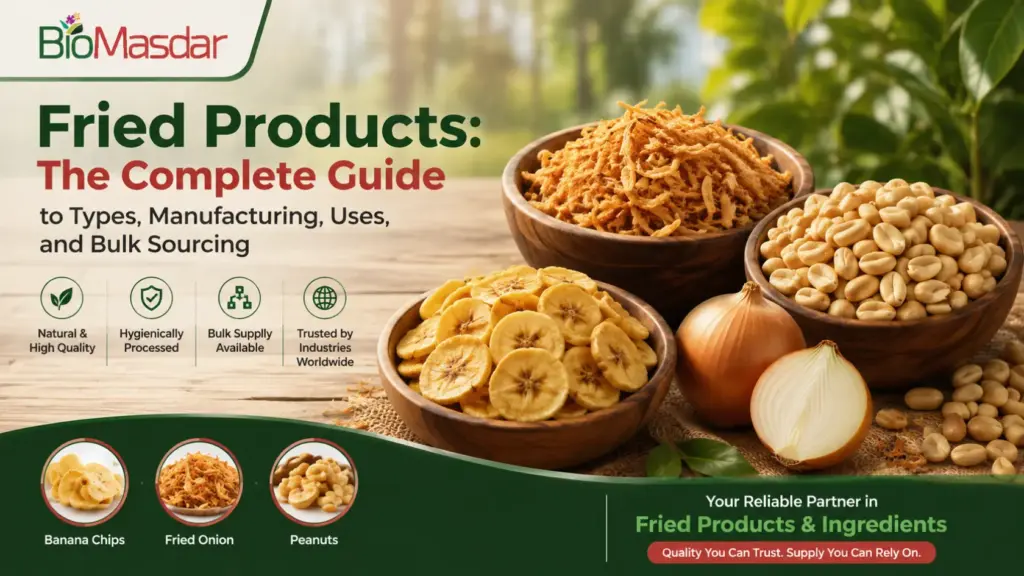
Fried products are foods that have been cooked in hot oil until they develop a crisp exterior, golden color, and concentrated flavor. This process – whether applied to fruits like bananas, vegetables like onions, or nuts like peanuts – removes surface moisture, creates texture through the Maillard reaction, and extends shelf life, making fried products a staple across snacking, food service, retail, and export markets.
This guide covers everything a buyer, food brand, or curious reader needs to know: what fried products are, how they’re made, where they’re used, how to judge quality, and how to choose a reliable bulk supplier such as BioMasdar, which manufactures and exports fried products including banana chips, fried onions, and peanuts from Pakistan.
What Are Fried Products?
Fried products are ingredients or snacks that are cooked in hot oil (typically 140-180°C) to remove moisture, develop crispness, and lock in flavor. The category spans fruit, vegetable, legume, and grain-based items – such as banana chips, fried onions, and fried peanuts – that are used both as standalone snacks and as functional ingredients in other food products, like garnishes, toppings, or inclusions.
Unlike raw or dehydrated ingredients, fried products go through an oil-cooking step that changes their texture (crisp, crunchy), color (golden to deep brown), and taste (nuttier, sweeter, or more savory depending on the base ingredient), while also giving them a longer, more stable shelf life for bulk transport and storage.
How Are Fried Products Made?
Commercial fried product manufacturing generally follows five stages:
- Sourcing and grading – Raw materials (bananas, onions, peanuts, etc.) are selected for size, ripeness, and quality consistency.
- Cleaning and preparation – Ingredients are washed, peeled, and sliced or sorted to a uniform size so they fry evenly.
- Frying – The prepared ingredient is cooked in edible oil at a controlled temperature and time, which determines the final crunch, color, and oil retention.
- Draining and cooling – Excess oil is removed (often via centrifugal draining) and the product is cooled to stop the cooking process and stabilize texture.
- Seasoning, packing, and quality control – Products may be lightly salted or left plain, then packed in moisture-proof bulk packaging and checked against food safety and quality benchmarks before dispatch.
This is the same core process – refined at industrial scale – that BioMasdar uses to produce its bulk fried products for snack manufacturers, food service operators, and retailers.
Main Types of Fried Products
While “fried products” is a broad category, most commercial demand centers on a few core types:
1. Fried Fruit Chips (e.g., Banana Chips)
Thin slices of fruit – most commonly banana – fried until golden and crisp. Banana chips are valued for their natural sweetness, satisfying crunch, and versatility; they’re eaten on their own, mixed into trail snacks, or used as a topping for desserts and cereals.
2. Fried Vegetables (e.g., Fried Onions)
Sliced vegetables fried to a crisp, concentrated form. Fried onions are one of the most widely used fried products in food service and manufacturing – used as a garnish on burgers, rice dishes, and casseroles, or as a flavor-boosting ingredient blended into seasonings, gravies, and instant noodle toppings.
3. Fried Legumes and Nuts (e.g., Peanuts)
Legumes such as peanuts are fried to enhance crunch and roasted flavor, then typically salted or seasoned. They’re sold as standalone snacks, used in trail and nut mixes, or added as an ingredient in bakery, confectionery, and savory snack products.
4. Other Fried Snack Ingredients
Depending on the market, the category can extend to fried lentils, fried garlic, fried potato products, and fried grain-based snacks – all following the same frying-based production logic.
Industries That Use Fried Products
Fried products aren’t just retail snacks – they’re a functional ingredient category used across several industries:
|
Industry |
Typical Use of Fried Products |
|
Snack & confectionery manufacturing |
Standalone packaged snacks, trail mixes, snack blends |
|
Food service (HORECA) |
Garnishes and toppings (e.g., fried onions on burgers, rice, curries) |
|
Retail & grocery |
Bulk repacking into private-label or branded snack bags |
|
Bakery |
Inclusions and toppings in bread, savory pastries, and snack bars |
|
Export & trading |
Bulk sourcing for international distribution and food manufacturing |
What Makes a High-Quality Fried Product?
Buyers evaluating fried products for bulk purchase should look at:
- Consistent slice size and color – indicates controlled, uniform frying rather than manual, inconsistent batches
- Low oil rancidity – fresh, properly drained products won’t taste greasy or stale
- Crunch retention – quality fried products stay crisp through packaging, transport, and shelf life
- Food safety compliance – certifications such as Halal status and adherence to recognized food safety standards
- Traceable sourcing – suppliers who can confirm origin and processing standards for their raw materials
- Packaging suited for bulk logistics – moisture-barrier packaging that protects crunch and flavor over long-distance shipping
Fried Products vs. Baked or Dehydrated Snacks
A common question buyers and consumers ask is how fried products differ from baked or dehydrated alternatives:
- Fried products are cooked in oil, producing a distinct crisp texture, richer flavor, and typically a shorter, more efficient production cycle.
- Baked products use dry heat instead of oil, resulting in a lighter texture and lower oil content, but often a longer bake time.
- Dehydrated products remove moisture through air-drying or low-heat drying without oil, producing a chewier or more brittle texture depending on the ingredient, with minimal added fat.
Each method suits different product goals – frying is generally chosen when a brand wants maximum crunch and a richer flavor profile in a shorter production window.
How to Choose a Bulk Fried Products Supplier
If you’re sourcing fried products for a snack brand, food service business, or export operation, evaluate suppliers on:
- Production capability – Can they consistently deliver bulk volumes without quality drift between batches?
- Range of products – A supplier offering multiple fried product lines (fruit, vegetable, nut-based) simplifies sourcing under one vendor.
- Certifications – Halal certification and food safety compliance are essential for most international and domestic buyers.
- Export experience – Suppliers experienced in export logistics reduce risk for cross-border buyers.
- Customization – Ability to adjust slice thickness, seasoning, and packaging formats to match your product specs.
Why BioMasdar for Bulk Fried Products
BioMasdar is a Pakistan-based supplier of natural ingredients for the food, pharma, nutraceutical, and cosmetic industries. Within its Fried Products line, BioMasdar supplies banana chips, fried onions, and peanuts in bulk for snack manufacturers, food service operators, retailers, and export buyers – offering crispy, ready-to-use products backed by consistent quality control from sourcing through packing.
For businesses that need a dependable bulk source of fried products alongside other natural ingredient categories (oleoresins, essential oils, seasonings, dehydrated fruits and vegetables), BioMasdar provides a single point of sourcing with quality and reliability built into its production process.
Answers to Common Questions
Q1. What are fried products?
Fried products are foods – such as fruit, vegetables, legumes, or nuts – that are cooked in hot oil to remove moisture and create a crisp texture, golden color, and concentrated flavor. Common examples include banana chips, fried onions, and fried peanuts.
Q2. What is the difference between fried and baked snacks?
Fried snacks are cooked in oil, giving them a crisper texture and richer flavor, while baked snacks are cooked with dry heat and generally contain less oil but take longer to prepare.
Q3. What are fried onions used for?
Fried onions are used as a garnish on dishes like burgers, rice, and curries, and as a flavor ingredient in seasonings, gravies, and packaged snack blends.
Q4. Are banana chips fried or baked?
Banana chips can be either fried or baked; fried banana chips have a crispier texture and richer flavor, while baked versions are typically lower in oil content.
Q5. How do I buy fried products in bulk?
Fried products can be sourced in bulk directly from manufacturers and suppliers like BioMasdar, which produces banana chips, fried onions, and peanuts for snack brands, food service businesses, retailers, and exporters.
Q6. What industries use fried products as an ingredient?
Fried products are used in snack and confectionery manufacturing, food service (HORECA), bakery, retail private-label packaging, and export/trading businesses.
Q7. Do fried products have a long shelf life?
Yes – when properly fried, drained, and packaged in moisture-barrier packaging, fried products like banana chips, fried onions, and peanuts can maintain their crunch and flavor for extended periods, making them suitable for bulk storage and export.
Wrapping Up
Fried products play a functional and versatile role across snacking, food service, retail, and export markets – offering crisp texture, concentrated flavor, and a longer shelf life than raw ingredients. Whether you’re a snack brand looking for a reliable ingredient supply, a food service operator sourcing garnishes at scale, or a retailer building out a private-label snack line, understanding how fried products are made and what separates a quality batch from an inconsistent one helps you make a smarter sourcing decision.
Looking for a dependable bulk supplier of fried products? Explore BioMasdar’s Fried Products range – including banana chips, fried onions, and peanuts – or contact BioMasdar to request bulk pricing and samples.