
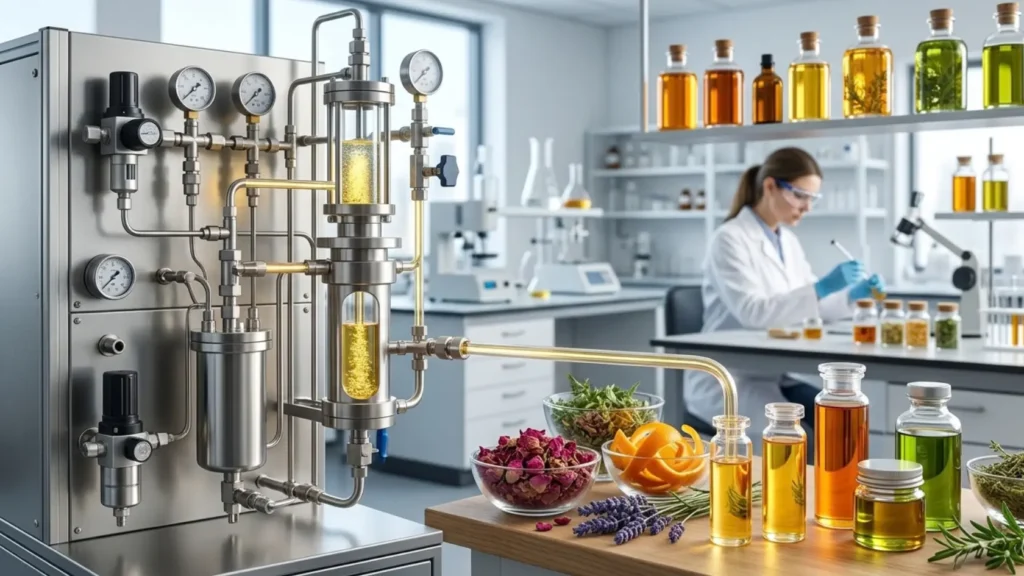
Supercritical CO₂ (carbon dioxide) extraction is the gold-standard technology behind today’s cleanest essential oils, oleoresins, cold-pressed oils, and spice extracts. If you’ve ever wondered how manufacturers pull pure, solvent-free actives from plants, herbs, and spices without leaving chemical residue behind, this guide covers everything – the science, the process, the benefits, and where it’s used across the food, flavor, fragrance, and nutraceutical industries.
At BioMasdar, supercritical CO₂ extraction sits at the core of how we produce food-grade oleoresins, essential oils, and specialty ingredients for manufacturers worldwide. This guide draws on that hands-on production experience to answer the questions people most often ask about the technology.
What Is Supercritical CO₂ Extraction?
Supercritical CO₂ extraction is a separation process that uses carbon dioxide in its supercritical state – a phase where it behaves as both a gas and a liquid simultaneously – as a solvent to pull out desirable compounds (oils, flavors, colors, aromas) from raw plant material.
CO₂ becomes “supercritical” above its critical point (31.1°C and 73.8 bar). In this state it diffuses through material like a gas but dissolves compounds like a liquid, making it an exceptionally efficient, tunable, and residue-free extraction medium.
Because CO₂ is naturally present in the atmosphere, non-toxic, non-flammable, and simply evaporates away after extraction, the process leaves no chemical solvent residue in the final product – a major advantage over traditional hexane or ethanol-based extraction.
How Does Supercritical CO₂ Extraction Work?
The process happens inside a sealed, pressurized extraction system and generally follows four steps:
1. Loading the Raw Material
Dried or fresh plant material (spices, herbs, fruit, seeds) is loaded into an extraction vessel.
2. Pressurizing the CO₂
Carbon dioxide gas is compressed and heated until it crosses its critical point, turning it into a supercritical fluid.
3. Extraction
The supercritical CO₂ is circulated through the raw material, dissolving essential oils, oleoresins, pigments, and other target compounds while leaving unwanted material behind.
4. Separation
Pressure is gradually reduced in a separator vessel. As pressure drops, CO₂ reverts to a gas and simply evaporates, leaving behind a pure, concentrated extract with zero solvent residue. The CO₂ gas is then recovered and recycled for reuse.
Why Is Supercritical CO₂ Extraction Better Than Traditional Methods?
| Factor | Supercritical CO₂ | Solvent Extraction (Hexane) | Steam Distillation | Cold Pressing |
| Residue-free | Yes | No (trace solvent risk) | Yes | Yes |
| Preserves heat-sensitive compounds | Yes (low temp) | Moderate | No (heat degrades aromatics) | Yes |
| Extraction purity | Very high | Moderate | Moderate | High (limited to oils) |
| Yield of full-spectrum compounds | High | High | Lower | Limited |
| Environmental impact | Low (CO₂ recycled) | Higher (chemical waste) | Moderate (energy-intensive) | Low |
| Suitable for delicate aromatics | Yes | Limited | Limited | N/A |
Key takeaway: Supercritical CO₂ extraction combines the purity of cold pressing with the extraction power of solvent methods – without the drawbacks of either.
What Products Are Made Using Supercritical CO₂ Extraction?
The technology is used across a wide range of natural ingredient categories, including:
- Oleoresins – concentrated flavor and color extracts from spices like paprika, turmeric, black pepper, and chili
- Essential Oils – aromatic oils from herbs, flowers, and spices used in flavoring, fragrance, and wellness products
- Cold Pressed Oils – complementary extraction for oil-rich seeds and nuts requiring minimal processing
- Pastes and Spreads – natural, concentrated bases used in food formulation
- Dehydrated Fruits, Vegetables and Spices – often paired with CO₂-extracted actives for enhanced flavor profiles
- Seasonings – standardized, potent flavor concentrates for food manufacturing
- Fried Products – ingredient inputs benefiting from purer, more stable oils
- Frozen Yoghurt Powders and Soft Serve Premix Powders – formulated using clean-label extracts and natural flavor bases
BioMasdar applies supercritical CO₂ extraction and complementary processing methods across this full product range to deliver consistent, food-safe, high-potency ingredients to manufacturers in the food, beverage, flavor, and nutraceutical industries.
What Are the Benefits of Supercritical CO₂ Extraction?
- No solvent residue – CO₂ fully evaporates, leaving a clean, food-safe extract.
- Preserves delicate compounds – Low operating temperatures protect volatile aromatics and heat-sensitive activities.
- Higher purity and potency – Produces concentrated, standardized extracts with consistent quality batch to batch.
- Environmentally friendly – CO₂ is recycled in a closed-loop system, and the gas used is often reclaimed from existing industrial sources rather than newly produced.
- Tunable selectivity – Adjusting pressure and temperature allows manufacturers to selectively target specific compounds.
- Longer shelf life – Extracts are more stable and less prone to oxidation compared to solvent-extracted alternatives.
Is Supercritical CO₂ Extraction Safe for Food Products?
Yes. Supercritical CO₂ extraction is widely recognized as one of the safest extraction methods for food-grade ingredients. Because CO₂ is non-toxic, non-flammable, and leaves no chemical residue after evaporation, extracts produced this way meet strict food safety standards and are suitable for clean-label formulations where consumers expect minimal processing aids.
Supercritical CO₂ Extraction vs. Cold Pressing: Which Is Better?
Neither method is universally “better” – they serve different purposes:
- Cold pressing is ideal for oil-rich raw materials (like seeds and nuts) where mechanical pressure alone can release the oil without heat or solvents.
- Supercritical CO₂ extraction is better suited for extracting a broader spectrum of compounds – including aromatics, pigments, and flavor concentrates – from materials where mechanical pressing alone can’t fully capture the desired compounds.
Many manufacturers, including BioMasdar, use both methods depending on the raw material and the target product, whether that’s a cold-pressed oil or a concentrated oleoresin.
Things You Might Be Wondering
Q1. What does “supercritical” mean in supercritical CO₂ extraction?
“Supercritical” refers to a physical state where a substance is held above both its critical temperature and critical pressure, causing it to exhibit properties of both a gas and a liquid at once. For CO₂, this occurs above 31.1°C and 73.8 bar.
Q2. Is CO₂ extraction the same as solvent extraction?
Not exactly. While CO₂ technically acts as a solvent, it differs from traditional solvents like hexane or ethanol because it leaves zero residue after extraction – it simply reverts to gas and evaporates, whereas chemical solvents require additional purification steps to remove trace residues.
Q3. How long does supercritical CO₂ extraction take?
Extraction time varies by raw material and target compound but typically ranges from a few hours to under a day per batch, making it faster than many traditional methods while producing a purer end product.
Q4. Is supercritical CO₂ extraction expensive?
The equipment investment is higher than for solvent extraction or cold pressing, but the CO₂ itself is inexpensive and fully recyclable, and the higher yield and purity often offset costs for manufacturers producing premium, clean-label ingredients.
Q5. What products use CO₂-extracted oleoresins and essential oils?
CO₂-extracted oleoresins and essential oils are used in food seasoning blends, beverages, sauces, snacks, nutraceuticals, cosmetics, and fragrance products, wherever manufacturers need concentrated, standardized, residue-free natural ingredients.
Q6. Does supercritical CO₂ extraction destroy nutrients or flavor compounds?
No. Because it operates at relatively low temperatures, supercritical CO₂ extraction preserves heat-sensitive compounds – including volatile aromatics and antioxidants – better than high-heat methods like steam distillation.
The Bottom Line
Supercritical CO₂ extraction has become the preferred method for manufacturers who need pure, potent, and residue-free natural extracts – from oleoresins and essential oils to specialty flavor concentrates. Its ability to preserve delicate compounds while eliminating solvent residue makes it a critical technology behind clean-label food and flavor ingredients today.
At BioMasdar, this process underpins our full range of natural ingredient solutions – including oleoresins, essential oils, cold pressed oils, pastes & spreads, dehydrated fruits, vegetables & spices, seasonings, fried products, and frozen yoghurt powders/soft serve premix powders – engineered to meet the purity, safety, and consistency standards manufacturers demand.
Ready to Source Cleaner, Purer Extracts?
Talk to the BioMasdar team today to explore how our supercritical CO₂-extracted oleoresins, essential oils, and specialty ingredients can elevate your product formulations. Contact BioMasdar →