
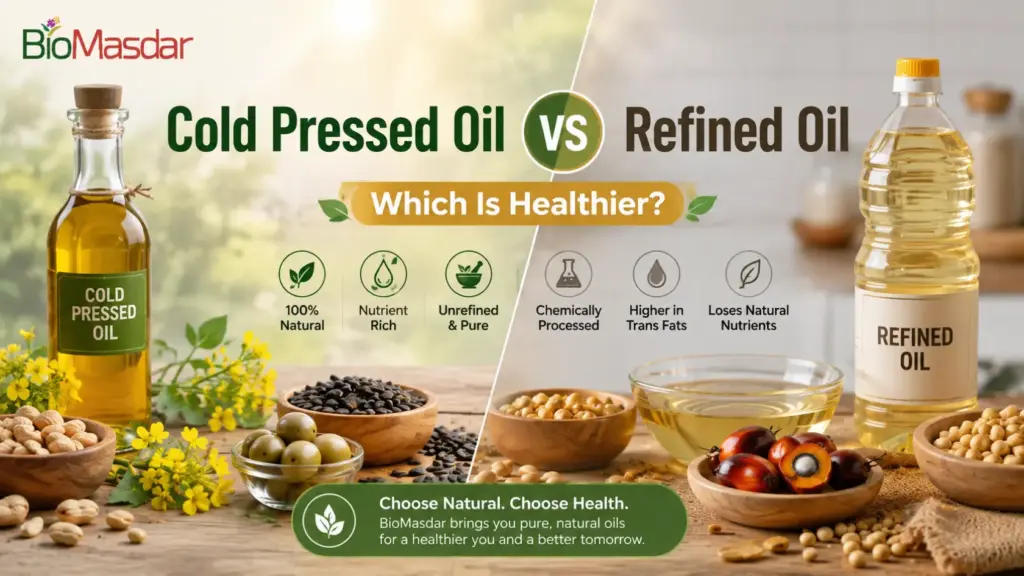
Cold pressed oil is extracted mechanically without heat or chemicals, preserving natural nutrients, antioxidants, and flavor. Refined oil is processed using high heat, bleaching, and chemical solvents (like hexane) to increase shelf life and neutralize taste, which strips away much of the oil’s original nutritional value. For daily cooking, salad dressings, and skin or hair care, cold pressed oil is the healthier choice. Refined oil is better suited for high-heat, large-scale commercial frying where a neutral taste and higher smoke point are needed.
What Is Cold Pressed Oil?
Cold pressed oil is extracted by mechanically crushing seeds, nuts, or kernels using a steel or wooden expeller, without applying external heat above 120°F (49°C). Because no heat or chemical solvents are used, the oil retains its natural color, aroma, taste, and nutrient profile – including vitamin E, polyphenols, and essential fatty acids.
This traditional method (sometimes called the “kachi ghani” or wood-pressed method in South Asia) is slower and yields less oil per batch than industrial refining, which is why cold pressed oils typically cost more but deliver higher nutritional value.
BioMasdar’s cold-pressed oil range is produced using this exact low-heat mechanical extraction process, ensuring every bottle retains the natural goodness of the raw seed or nut.
What Is Refined Oil?
Refined oil goes through an industrial multi-step process:
- Extraction – often using heat and chemical solvents like hexane to maximize oil yield
- Degumming – removing phospholipids
- Neutralizing – treating with alkali to remove free fatty acids
- Bleaching – using bleaching earth to remove color and impurities
- Deodorizing – high-temperature steam distillation to remove smell
This process produces a clear, odorless, long-shelf-life oil with a high smoke point, but many heat-sensitive nutrients and natural antioxidants are destroyed or removed along the way.
How Extraction Method Affects Oil Quality
The extraction method is the single biggest factor separating these two oil types:
| Factor | Cold Pressed | Refined |
| Heat used | Low (under 49°C) | High (above 200°C at stages) |
| Chemicals used | None | Hexane, bleaching agents, alkali |
| Nutrient retention | High | Low to moderate |
| Processing steps | 1 (mechanical pressing) | 5+ (multi-stage refining) |
Because cold pressing avoids heat and chemical exposure, it protects heat-sensitive compounds like vitamin E, polyphenols, and omega-3 fatty acids that would otherwise degrade.
Cold Pressed Oil vs Refined Oil: Full Comparison Table
| Feature | Cold Pressed Oil | Refined Oil |
| Extraction process | Mechanical pressing, no heat | Chemical solvents + high heat |
| Nutrient content | Retains vitamins, antioxidants, fatty acids | Significantly reduced |
| Color & aroma | Natural, distinct, oil-specific | Clear, neutral, odorless |
| Taste | Rich, authentic flavor of source seed/nut | Mild to no taste |
| Smoke point | Generally lower (varies by oil) | Generally higher |
| Shelf life | Shorter, best stored cool and dark | Longer, more stable |
| Additives | None | May contain preservatives, anti-foaming agents |
| Best for | Salad dressings, light sautéing, skin/hair care, raw consumption | Deep frying, high-heat commercial cooking |
| Price | Higher | Lower |
| Processing | Minimal, closer to natural state | Highly processed |
Nutritional Differences
Because refining involves high heat and chemical treatment, several nutrients found in the raw seed or nut are diminished or lost entirely:
- Vitamin E (tocopherols): Largely preserved in cold pressed oils; significantly reduced in refined oils due to bleaching and deodorizing.
- Polyphenols and antioxidants: Present in meaningful amounts in cold pressed oils; mostly stripped during refining.
- Essential fatty acids: Cold pressing better preserves the natural ratio of monounsaturated and polyunsaturated fats.
- Trans fats: High-heat refining can generate small amounts of trans fats, which cold pressing avoids entirely.
Health Benefits of Cold Pressed Oil
- Richer in antioxidants that help combat oxidative stress
- Better for heart health due to preserved unsaturated fat profiles
- Supports skin and hair when used topically, thanks to retained vitamin E and fatty acids
- Free from chemical residue, since no solvents are used in extraction
- Retains natural flavor and aroma, adding nutritional and culinary value to meals
For example, BioMasdar’s black seed oil is prized for its concentrated thymoquinone content, a compound largely researched for its antioxidant properties – something that would be diminished under high-heat refining.
Smoke Point Comparison
Smoke point is the temperature at which an oil starts to break down and smoke, releasing compounds that affect taste and may generate harmful free radicals. Here’s a general comparison for common oils:
| Oil | Cold Pressed Smoke Point (approx.) | Refined Smoke Point (approx.) |
| Coconut oil | 350°F / 177°C | 400°F+ / 204°C+ |
| Mustard oil | 480°F / 250°C (naturally high) | 480°F / 250°C |
| Sesame oil | 350°F / 177°C | 410°F / 210°C |
| Peanut oil | 320°F / 160°C | 450°F / 232°C |
| Almond oil | 420°F / 216°C | 470°F / 243°C |
Note: Not all cold pressed oils have low smoke points – mustard oil, for instance, naturally withstands high heat even in its unrefined form, making it suitable for Indian and South Asian style frying and tempering.
Taste, Aroma, and Color
Cold pressed oils carry the authentic taste and aroma of their source ingredient – nutty, earthy, or pungent depending on the seed or nut. Refined oils are intentionally deodorized and neutralized to have almost no smell or taste, which is preferred in food manufacturing where a neutral base is needed but is often seen as a drawback for home cooking and natural wellness use.
Cost Comparison
Cold pressed oils generally cost 30-70% more than refined oils. This is due to:
- Lower oil yield per batch (slower, mechanical extraction)
- Higher raw material usage
- Smaller-batch, artisanal-style production
- No cheap chemical solvents used to maximize yield
While the upfront cost is higher, many consumers consider cold pressed oil a better long-term value due to its concentrated nutrition and multi-purpose use (cooking, skincare, haircare).
Environmental and Sustainability Impact
Cold pressing is generally more environmentally friendly because it:
- Avoids hexane and other petroleum-based solvents
- Requires less industrial processing energy per batch
- Produces natural, biodegradable oil cake as a byproduct (often reused as animal feed or fertilizer)
Refined oil production, by contrast, is more energy- and chemical-intensive, though it does produce higher yields per unit of raw material, which some argue improves land-use efficiency.
Which Oil Should You Choose? (By Use Case)
| Use Case | Recommended Oil |
| Salad dressings & dips | Cold pressed |
| Light sautéing & everyday cooking | Cold pressed |
| Deep frying at commercial scale | Refined |
| Skin and hair application | Cold pressed |
| Baking (neutral flavor needed) | Refined |
| Traditional/Ayurvedic wellness use | Cold pressed |
| Long shelf-life bulk storage | Refined |
If your priority is nutrition, natural flavor, and multi-purpose wellness use, cold pressed oil is the clear winner. If you need a neutral-tasting oil for high-volume commercial frying, refined oil may be more practical.
Best Cold Pressed Oils to Try
BioMasdar offers a full range of traditionally extracted, wood-pressed and cold-pressed oils, each suited to different cooking and wellness needs:
- Almond Oil – rich in vitamin E, popular for skincare and light cooking
- Black Seed Oil – known for its antioxidant-rich profile and traditional wellness use
- Coconut Oil – versatile for cooking, hair care, and skin nourishment
- Mustard Oil – naturally high smoke point, ideal for South Asian cooking
- Peanut Oil – nutty flavor, great for stir-fries and everyday use
- Sesame Oil – aromatic, antioxidant-rich, popular in Asian and Middle Eastern cuisine
Explore the complete lineup on the BioMasdar Cold-Pressed Oils page.
Quick Questions & Answers
Q1. Is cold pressed oil better than refined oil?
Yes, for most everyday uses. Cold pressed oil retains more natural nutrients, antioxidants, and flavor because it’s extracted without heat or chemicals. Refined oil offers a longer shelf life and higher smoke point but loses much of its original nutritional value during processing.
Q2. What is the main difference between cold pressed oil and refined oil?
The main difference is the extraction process. Cold pressed oil is mechanically extracted without heat, while refined oil undergoes multiple chemical and high-heat processing steps, including bleaching and deodorizing.
Q3. Does cold pressed oil have a lower smoke point than refined oil?
Generally, yes, but it depends on the oil type. Refined oils typically have higher smoke points because processing removes particles that burn at lower temperatures. However, some cold pressed oils, like mustard oil, naturally have a high smoke point even without refining.
Q4. Can cold pressed oil be used for frying?
Yes, but it’s best suited for light to medium-heat cooking rather than deep frying, unless the specific oil (like mustard or peanut oil) has a naturally high smoke point. For daily sautéing, roasting, and tempering, cold pressed oil works well.
Q5. Why is cold pressed oil more expensive than refined oil?
Cold pressed oil costs more because the extraction process yields less oil per batch, uses more raw material, and requires slower, small-batch mechanical pressing without cheap chemical solvents.
Q6. Is refined oil bad for health?
Refined oil is not inherently unsafe, but the refining process removes many natural antioxidants and nutrients, and can generate trace amounts of trans fats during high-heat processing. Moderate consumption as part of a balanced diet is generally considered acceptable.
Q7. Which cold pressed oil is best for skin and hair?
Cold pressed almond oil, coconut oil, and sesame oil are widely used for skin and hair care due to their vitamin E content and moisturizing properties, as they retain natural fatty acids that refined oils lose during processing.
Q8. Is cold pressed oil the same as virgin oil?
Not always. “Cold pressed” refers to the extraction method (no heat used), while “virgin” typically refers to the oil being unrefined and from the first pressing. Many cold pressed oils are also virgin oils, but the terms aren’t strictly interchangeable across all oil types.
Closing Thoughts
When comparing cold pressed oil vs refined oil, the choice ultimately comes down to your priority: nutrition and natural flavor, or shelf life and high-heat cooking convenience. Cold pressed oil wins on nutrient retention, antioxidant content, and multi-purpose wellness use, making it the better everyday choice for most households. Refined oil still has a place in commercial kitchens and high-volume frying where a neutral taste and higher smoke point matter more.
For those looking to make the healthier switch, BioMasdar’s traditionally extracted cold-pressed oils offer a natural, chemical-free alternative – pressed the way nature intended.
Ready to Make the Switch?
Explore BioMasdar’s full range of pure, wood-pressed and cold-pressed oils – from almond and black seed to coconut, mustard, peanut, and sesame oil – and bring authentic, nutrient-rich oils into your kitchen today. Contact BioMasdar Today →