
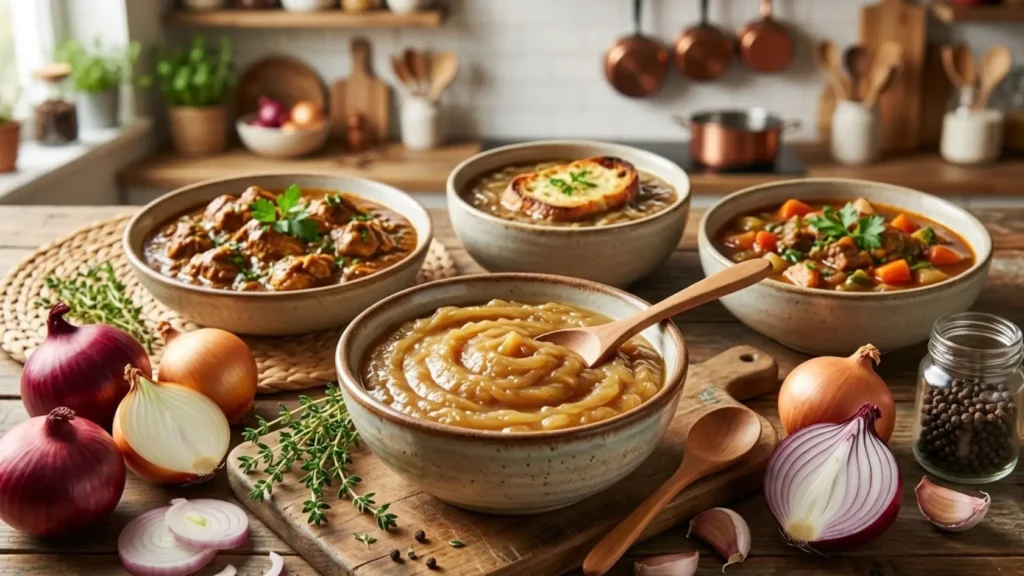
Onion paste is one of the most quietly essential ingredients in commercial and home kitchens – a smooth, concentrated base made from fresh onions that instantly builds flavor in curries, gravies, marinades, and processed foods. If you’ve ever wondered what onion paste actually is, how it differs from onion powder or paste-in-a-jar alternatives, or how food manufacturers source it in bulk, this guide answers every question in one place.
Onion paste is a smooth, ready-to-use puree made by grinding fresh, peeled onions (sometimes with minimal water or oil) into a consistent paste. It’s used to add natural onion flavor, aroma, and moisture to dishes and processed foods without the prep time of chopping or the inconsistency of raw onions. BioMasdar supplies hygienically processed, bulk-ready onion paste to restaurants, food manufacturers, and distributors across Pakistan and beyond.
What Is Onion Paste?
Onion paste is a smooth, semi-liquid preparation made by finely grinding fresh onions until they reach a uniform, spreadable consistency. Unlike diced or minced onion, paste has no chunks or fibrous texture, which means it blends evenly into sauces, gravies, and batters and cooks down faster because there’s no cell structure left to break down.
In commercial food production, onion paste functions as a flavor base ingredient – the same role that tomato paste, ginger paste, or garlic paste plays. It’s classified within the broader pastes and spreads category of processed vegetable ingredients, alongside products like ginger-garlic paste and tomato puree.
Key characteristics of quality onion paste:
- Smooth, lump-free consistency
- Natural onion aroma and sweetness (no burnt or fermented notes)
- Consistent color (pale yellow to off-white) and moisture content batch to batch
- Free from added preservatives when labeled “natural” or “clean-label”
- Hygienically processed to reduce microbial load for food-safety compliance
How Onion Paste Is Made
Commercial onion paste production generally follows these steps:
- Sourcing – Fresh, high-quality onions are selected and graded for size, moisture, and pungency.
- Cleaning & Peeling – Onions are washed and mechanically peeled to remove skin and root ends.
- Grinding – Peeled onions are ground or milled into a fine, uniform paste, sometimes with a small amount of water added to reach the right texture.
- Processing & Pasteurization – The paste is hygienically processed to extend shelf life and meet food-safety standards, without compromising natural flavor.
- Packing – The finished paste is packed in food-grade containers (drums, pails, or pouches) sized for retail, HoReCa (hotel/restaurant/catering), or industrial bulk use.
This process is what separates a genuine ready-to-use onion paste from simply blending an onion at home – commercial processing controls consistency, shelf stability, and food-safety parameters at scale.
Onion Paste vs. Onion Powder vs. Fresh Onions
A common question among home cooks and procurement teams alike is which onion format to use. Here’s a direct comparison:
| Factor | Onion Paste | Onion Powder | Fresh Chopped Onion |
| Prep time | None – ready to use | None – ready to use | High (peeling, chopping) |
| Texture in dish | Smooth, blends seamlessly | Dry, no moisture added | Chunky, uneven cooking |
| Flavor intensity | Close to fresh onion | Concentrated, drier flavor | Fresh, sharp raw flavor |
| Moisture content | High (adds body to gravies) | None | Moderate |
| Shelf life | Weeks to months (chilled/processed) | Months to years (dry) | Days |
| Best for | Curries, gravies, marinades, sauces | Dry rubs, seasoning blends | Salads, garnish, raw use |
| Consistency across batches | High | High | Variable |
In short: choose onion paste when a recipe or formulation needs moisture, smooth texture, and fast-cooking onion flavor; choose onion powder for dry applications like spice blends; choose fresh onion when texture and bite matter (like in salads or garnishes).
Top Uses of Onion Paste
Onion paste is versatile across both home cooking and industrial food manufacturing.
In Home & Restaurant Cooking
- Curries and gravies – forms the flavor base for South Asian and Middle Eastern dishes
- Marinades – tenderizes and flavors meat, poultry, and paneer
- Sauces and gravies for fast food – burger sauces, kebab rolls, shawarma-style wraps
- Soups and stews – adds body and umami depth
- Rice dishes – biryani, pulao, and fried rice bases
In Food Manufacturing & Processing
- Ready-to-eat (RTE) and ready-to-cook (RTC) meals
- Instant sauces, ketchups, and condiments
- Snack seasoning and savory food coatings
- Frozen food formulations (parathas, nuggets, patties)
- Soup powders and bouillon bases
This dual use – culinary and industrial – is why onion paste is sourced both by individual chefs and by procurement teams at food processing companies.
Benefits of Using Onion Paste
- Saves preparation time – no peeling, chopping, or blending required, which matters in high-volume kitchens and production lines.
- Consistent flavor and texture – every batch delivers the same taste and consistency, reducing recipe variation.
- Better ingredient blending – the smooth texture disperses evenly through sauces and gravies, unlike chopped onion which can burn or brown unevenly.
- Reduces kitchen waste – no peels, ends, or spoiled raw onions to discard.
- Longer usable shelf life – properly processed and stored paste lasts significantly longer than fresh cut onion.
- Scalable for bulk production – food manufacturers can standardize formulations more easily with a uniform paste than with variable fresh produce.
How to Store Onion Paste
- Refrigeration: Keep opened onion paste refrigerated (below 4°C) and use within the timeframe stated on the packaging.
- Freezing: For longer storage, onion paste can be portioned and frozen in airtight containers or ice-cube trays for easy single-use portions.
- Airtight sealing: Always reseal the container tightly after use to prevent oxidation, which can dull flavor and color.
- Avoid cross-contamination: Use a clean, dry spoon each time to extend shelf life and food safety.
- Bulk/industrial storage: Commercial buyers should store drums or pails per the supplier’s technical data sheet, typically in cool, dry conditions away from direct sunlight.
Buying Onion Paste in Bulk: What to Look For
If you’re a restaurant chain, food manufacturer, or distributor sourcing onion paste in bulk, evaluate suppliers against these criteria:
- Consistency of raw material sourcing – Are onions graded and sourced from reliable regions?
- Hygiene and food-safety certification – Does the facility follow food-safety standards (HACCP, Halal, ISO, or equivalent)?
- Clean-label formulation – Is the paste free from unnecessary additives, or clearly labeled if preservatives are used?
- Batch consistency – Can the supplier guarantee uniform taste, color, and texture across orders?
- Packaging options – Does the supplier offer packaging suited to your volume (drums, pails, or customized bulk packaging)?
- Reliable supply capacity – Can the manufacturer meet recurring, large-volume orders without delays?
- Traceability – Can the supplier document sourcing and processing for audit or quality-control purposes?
Why Choose BioMasdar Onion Paste
BioMasdar is a Pakistan-based supplier of natural ingredients serving the food, pharma, nutraceutical, and cosmetic industries. Its onion paste is made from carefully selected, high-quality onions, finely ground to preserve natural sweetness and aroma, and hygienically processed and packed to retain freshness.
What makes it a strong sourcing option for bulk buyers:
- Ready-to-use consistency – smooth texture designed for easy blending and uniform distribution in cooking and processing
- Authentic onion flavor – no compromise on taste compared to fresh onions
- Built for both home and professional use – suited to individual kitchens as well as industrial food production
- Part of a broader natural ingredients portfolio – BioMasdar also supplies oleoresins, essential oils, cold-pressed oils, dehydrated fruits and vegetables, and seasonings, making it a one-stop sourcing partner for food manufacturers
- Pakistan-based supply with export capability – positioned to serve both local HoReCa/food-processing demand and international bulk buyers
For businesses evaluating a bulk onion paste supplier in Pakistan, BioMasdar’s combination of hygienic processing, consistent quality, and broader ingredient catalog makes it a practical single-vendor solution.
What People Usually Ask
Q1. What is onion paste made of?
Onion paste is made from fresh, peeled onions that are ground into a smooth consistency, sometimes with a small amount of water added to achieve the right texture. Quality onion paste, like BioMasdar’s, contains no unnecessary fillers.
Q2. Is onion paste the same as onion puree?
They’re very similar. “Onion paste” and “onion puree” are often used interchangeably to describe finely ground onions with a smooth consistency, though “paste” sometimes implies a slightly thicker texture used specifically as a cooking base.
Q3. How long does onion paste last?
Refrigerated, properly sealed onion paste typically lasts one to two weeks; frozen paste can last several months. Always check the specific supplier’s shelf-life guidance on the packaging.
Q4. Can onion paste replace fresh onions in recipes?
Yes, in most cooked applications like curries, gravies, and marinades, onion paste can directly replace fresh onions and often cooks down faster since there’s no cell structure left to break.
Q5. Is onion paste healthy?
Onion paste retains much of the nutritional profile of fresh onions, including natural antioxidants and flavor compounds, as long as it’s minimally processed without excessive additives.
Q6. How much onion paste equals one fresh onion?
As a general guide, about 1 tablespoon of onion paste is roughly equivalent to one small fresh onion, though this varies by paste concentration and recipe.
Q7. Where can I buy onion paste in bulk in Pakistan?
BioMasdar supplies hygienically processed, bulk-ready onion paste for restaurants, food manufacturers, and distributors across Pakistan. Visit the onion paste product page or contact BioMasdar to request pricing and samples.
Q8. What industries use onion paste besides restaurants?
Onion paste is widely used in ready-to-eat and ready-to-cook meal production, sauce and condiment manufacturing, snack seasoning, frozen food formulation, and soup or bouillon production.
Bringing It All Together
Onion paste has become a go-to ingredient for anyone who wants consistent, authentic onion flavor without the prep time or unpredictability of fresh onions – whether that’s a home cook building a weeknight curry or a food manufacturer formulating a shelf-stable sauce at scale. Its smooth texture, natural sweetness, and versatility across curries, marinades, sauces, and processed foods make it a staple across both home and industrial kitchens.
For businesses and bulk buyers, the choice of supplier matters just as much as the ingredient itself – consistency, hygiene, and reliable supply capacity are what separate a good onion paste from a great one.
Ready to Source Premium Onion Paste?
BioMasdar offers fresh, hygienically processed, ready-to-use onion paste in bulk quantities for restaurants, food manufacturers, and distributors. Explore BioMasdar’s onion paste or contact the team to request a quote and product samples.