
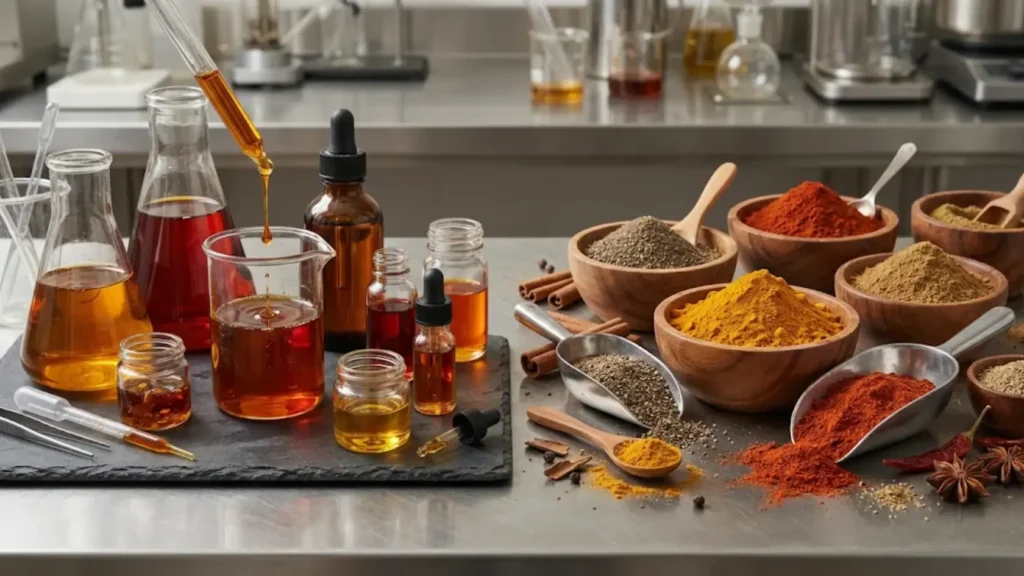
For most food manufacturers producing at scale, spice oleoresins deliver better ROI than ground spices. They cost more per kilogram, but one kilogram replaces roughly 10 to 25 kilograms of ground spice, depending on the spice and grade. They also give a standardized flavor batch after batch, carry a far lower microbial risk, last longer in storage, and cut freight, warehousing and rework costs. Ground spices still win where visible specks, a “whole spice” label or very small batch runs matter more than consistency.
Key Takeaways
- Compare spices on cost-in-use, not price per kilogram.
- Oleoresins are standardized to measurable markers such as piperine, capsaicin (SHU) or color value (ASTA), so every batch tastes the same.
- Ground spices often need steam sterilization or irradiation to meet microbial limits, which adds cost and dulls flavor.
- Oleoresins take up a fraction of the storage space and lose less potency over 12 to 24 months.
- A hybrid approach, oleoresin for flavor plus a small amount of ground spice for appearance, often gives the best of both.
What Are Spice Oleoresins?
A spice oleoresin is the concentrated extract of a spice that holds both its volatile aroma oils and its non-volatile flavor, heat and color compounds. It is the “whole flavor” of the spice in liquid or semi-solid form, without the fiber, starch and dust.
Oleoresins are made in four broad steps:
- Selection and grinding. Dried spice is cleaned and coarsely ground to open its cells.
- Extraction. A food-grade solvent such as ethanol, acetone or hexane, or supercritical CO2, pulls out the flavor-active compounds.
- Solvent removal. The solvent is evaporated and recovered so residues stay within food safety limits.
- Standardization. The extract is blended and tested to a fixed strength, for example piperine content in black pepper oleoresin or Scoville Heat Units in capsicum oleoresin.
The result is a product that is potent, uniform and close to sterile. Because the active compounds are measured, a manufacturer knows exactly how much flavor goes into every batch.
Oleoresin vs essential oil: an essential oil captures only the volatile aroma fraction. An oleoresin keeps the aroma and the pungency, bite and color, so it tastes much closer to the real spice.
Ground Spices: Familiar but Costly at Scale
Ground spices are dried spices milled into powder, and they remain the default in home kitchens and small food businesses. At industrial volumes, though, five problems start to show up on the balance sheet.
- Variable strength. Flavor and heat change with origin, harvest, rainfall and storage. Two lots of the same black pepper can differ noticeably in piperine, forcing recipe adjustments.
- Microbial load. Spices are dried in the open and often carry high counts of bacteria, yeast, mold and spores. Many lots need steam sterilization or irradiation before use, and Salmonella in spices is a recurring cause of product recalls.
- Contaminants and adulteration. Aflatoxins, pesticide residues, stones, dust and fillers have to be tested for and managed on every lot.
- Potency loss. Once ground, spices lose their volatile oils quickly, especially in warm and humid warehouses.
- Bulk and handling. Large bags take up storage space, create dust on the production floor and raise cleaning and allergen-control effort.
None of these costs appear on the purchase invoice, which is why ground spices often look cheaper than they really are.
Oleoresins vs. Ground Spices: Side-by-Side Comparison
Oleoresins come out ahead on eight of these eleven factors; ground spices win only on visible specks, simple labeling and sticker price per kilogram.
| Factor | Spice oleoresins | Ground spices |
| Strength | 10 to 25 times stronger by weight (approximate, varies by spice and grade) | 1x baseline |
| Batch consistency | Standardized to a measured marker (piperine, SHU, ASTA) | Varies by crop, origin and storage |
| Microbial load | Very low; the extraction process acts as a kill step | Often high; may need sterilization |
| Shelf life | Typically 12 to 24 months in sealed containers | Volatile oils fade within months once ground |
| Storage space | A drum replaces many bags | Bulky; needs dry, cool storage |
| Freight cost | Low weight per flavor unit | High weight per flavor unit |
| Dosing | Precise; easy to automate | Approximate; dusty to handle |
| Dispersion | Even, once plated on a carrier or emulsified | Can clump or settle |
| Visual specks | None (clear or colored liquid) | Visible particles |
| Labeling | “Spice extract” or “natural flavoring” (check local rules) | “Spices” or the spice name |
| Price per kg | Higher | Lower |
7 Factors That Determine Spice ROI in Food Manufacturing
Spice ROI depends on the total cost of delivering a fixed amount of flavor into the finished product, not on the price per kilogram. These seven factors make up that total.
1. Cost per Unit of Flavor
Divide the price of each option by its flavor strength. If 1 kg of black pepper oleoresin does the work of about 15 to 20 kg of ground pepper, the oleoresin can cost up to 15 to 20 times more per kilogram and still break even on raw material alone.
2. Standardization and Fewer Rejected Batches
A standardized oleoresin removes the need to re-test and re-adjust recipes every time a new spice lot arrives. That means fewer off-spec batches, fewer customer complaints and less QC time per production run.
3. Microbial Safety and Recall Risks
The heat and solvent used in extraction leave oleoresins with a very low microbial count. Manufacturers can often skip the sterilization step that ground spices need, and they lower the risk of a Salmonella-linked recall, which can cost far more than a year of spice purchases.
4. Shelf Life and Inventory Losses
Sealed oleoresins hold their strength for 12 to 24 months under proper storage. Ground spices lose aroma faster, so stock that sits too long either gets written off or is used at a higher dose to compensate.
5. Freight, Storage, and Handling
One drum of oleoresin can replace a pallet or more of bagged spice. That cuts inbound freight, warehouse space, pest-control effort and labor for moving stock.
6. Processing Efficiency
Liquid or plated oleoresins dose accurately through pumps and automated systems. They produce no dust, shorten cleaning time between runs and blend evenly in sauces, brines, oils and seasonings.
7. Yield and Waste Reduction
Ground spice leaves behind husk, fiber and settled sediment that carry no flavor. With oleoresins, almost everything you pay for ends up as flavor in the product.
How to Calculate Spice ROI: A Worked Example
In this illustrative case, switching from ground black pepper to black pepper oleoresin cuts annual spice cost by about 27%. The numbers below are hypothetical, in USD, for a plant that uses the flavor equivalent of 10,000 kg of ground black pepper a year at a 1:16 replacement ratio. Replace them with your own supplier quotes.
Use this cost-in-use formula for each option:
- Cost in use = Material cost + Treatment + Freight and storage + Carrier or processing + Losses + Rework
| Cost line (USD per year) | Ground black pepper | Black pepper oleoresin |
| Quantity needed | 10,000 kg | 625 kg |
| Material cost | 70,000 (at 7/kg) | 59,375 (at 95/kg) |
| Steam sterilization | 4,000 | 0 |
| Freight and storage | 5,000 | 500 |
| Carrier or plating | 0 | 1,500 |
| Potency loss and write-offs | 3,500 | 594 |
| Rework and QC rejections | 4,000 | 1,000 |
| Total cost in use | 86,500 | 62,969 |
| Annual saving | 23,531 (about 27%) |
Notice that the oleoresin is more than 13 times dearer per kilogram, yet it still costs less overall. The hidden costs of ground spice, sterilization, freight, spoilage and rework, add more than 23% on top of its purchase price in this example.
To find your own break-even price for an oleoresin, divide the total cost in use of the ground spice by the kilograms of oleoresin you would need.
When Ground Spices Still Make Sense
Ground spices remain the better choice when the look of the spice, the label or the batch size matters more than consistency and cost-in-use. Typical cases:
- Visible specks are part of the product. Pepper flecks on crackers, herb pieces in dressings or chili flakes on snacks signal flavor to the shopper.
- “Whole spice” or artisanal claims. Some brands market ground spice on the label as part of their positioning.
- Very small or irregular batches. Low volumes may not justify the handling setup for liquid extracts.
- Dry blends sold to consumers. Retail spice mixes are expected to look and feel like real spice.
The Hybrid Approach
Many manufacturers combine both. An oleoresin delivers the standardized flavor, heat and color, while a small dose of ground or cracked spice adds visual appeal. This keeps the consistency and safety benefits while cutting ground spice use, and its hidden costs, sharply.
Where Oleoresins Deliver the Strongest ROI
The return is highest in high-volume, liquid or fat-based products where flavor must be uniform and microbial limits are strict.
| Industry | Typical products | Why oleoresins pay off |
| Snacks and namkeen | Chips, extruded snacks, nuts | Even coating via plated seasoning; consistent heat |
| Meat and poultry processing | Sausages, kebabs, marinated and frozen meat | Low microbial load; even distribution in brines and emulsions |
| Sauces, ketchups and dressings | Chili sauce, mayonnaise, gravies | No specks or sediment; stable color |
| Ready meals and instant noodles | Seasoning sachets, curries, soups | Exact dosing; long shelf life |
| Pickles and canned foods | Achar, canned vegetables | Disperses in oil; withstands heat processing |
| Bakery and dairy | Savory biscuits, cheese spreads | Clean appearance; consistent taste |
| Beverages | Ginger or spiced drinks, cardamom tea premixes | Soluble forms give clear, uniform flavor |
| Nutraceuticals | Capsules, functional blends | Measured active compounds such as piperine |
BioMasdar Spice Oleoresins for Food Manufacturers
BioMasdar supplies five spice oleoresins that cover the most-used savory flavors in processed food. Each one replaces a ground spice that is commonly hard to source at consistent quality.
| BioMasdar product | Replaces | What it delivers | Common uses |
| Black Pepper Oleoresin | Ground black pepper | Pungent bite (piperine) and warm pepper aroma | Snacks, meat products, sauces, soups, seasonings |
| Capsicum Oleoresin | Chili powder | Controlled heat (capsaicin, measured in SHU) | Hot sauces, snacks, marinades, ready meals, noodles |
| Cardamom Oleoresin | Ground cardamom | Sweet, cooling, floral aroma | Bakery, dairy desserts, tea premixes, beverages, confectionery |
| Garlic Oleoresin | Garlic powder and fresh garlic | Strong, savory garlic flavor without peeling or odor on the line | Dressings, meat, snacks, sauces, frozen food |
| Coriander Oleoresin | Ground coriander seed | Citrusy, earthy, warm notes | Curry blends, pickles, sausages, gravies, seasonings |
Ask the BioMasdar team for the specification sheet, recommended dosage and replacement ratio for each grade before trials, since strength varies by grade and application.
How to Switch from Ground Spices to Oleoresins in 6 Steps
A typical switch takes one to three trial rounds and starts with the spice you buy in the largest volume.
- Audit current spice use. List each spice, annual volume, price, sterilization cost and any batch rejections linked to spice quality.
- Pick the highest-impact spice first. Black pepper and chili usually give the fastest payback because of their volume and variability.
- Get the specification and replacement ratio. Ask your supplier for the strength marker, recommended dose and a sample.
- Choose the delivery format. Plate the oleoresin on salt, dextrose or maltodextrin for dry seasonings; disperse it in oil for fat-based products; use a water-soluble or emulsified form for beverages and brines.
- Run sensory and shelf-life trials. Match the current taste profile at bench scale, then confirm on a pilot batch.
- Update specs, labels and HACCP records. Revise ingredient declarations to local regulations and add the oleoresin to supplier approval and QC plans.
Let’s Explore Your Questions
Q1. Are oleoresins more cost-effective than ground spices?
Yes, for most food manufacturers. Oleoresins cost more per kilogram, but 1 kg replaces about 10 to 25 kg of ground spice and removes costs for sterilization, freight, storage losses and rework. On a cost-in-use basis, they are usually cheaper.
Q2. How much ground spice does 1 kg of oleoresin replace?
It depends on the spice and grade. As a rough guide, 1 kg of black pepper oleoresin replaces about 15 to 20 kg of ground black pepper. Always confirm the ratio with the supplier’s specification sheet and your own trials.
Q3. Do oleoresins taste the same as ground spices?
Oleoresins capture both the aroma and the pungency of the spice, so they taste very close to the original. They lack the texture and visible specks of ground spice, which is why some products use a little ground spice alongside.
Q4. Are spice oleoresins safe to use in food?
Yes. Spice oleoresins are widely used, food-grade ingredients when produced under good manufacturing practice with solvent residues kept within regulatory limits. They also carry a much lower microbial load than raw ground spices.
Q5. What is the shelf life of spice oleoresins?
Most spice oleoresins keep their strength for 12 to 24 months in sealed containers, stored cool and away from light. Ground spices lose aroma faster once milled.
Q6. How do you use oleoresins in dry seasonings?
Oleoresins are plated onto a dry carrier such as salt, dextrose or maltodextrin to make a free-flowing powder. This powder then blends evenly into seasonings, snack coatings and dry mixes.
Q7. What is the difference between an oleoresin and an essential oil?
An essential oil contains only the volatile aroma compounds. An oleoresin contains the aroma plus the non-volatile flavor, heat and color compounds, so it gives a fuller, more authentic spice taste.
Q8. Which foods benefit most from oleoresins?
High-volume products such as snacks, processed meat, sauces, ready meals, instant noodles, pickles and beverages benefit most. These need uniform flavor, strict microbial control and accurate dosing.
Bringing It All Together
For food manufacturers producing at scale, spice oleoresins usually deliver a better return on investment. Ground spices look cheaper on the invoice, but their real cost includes sterilization, freight, storage, potency loss, recalls and rejected batches. Oleoresins remove most of those hidden costs and give the same flavor in every batch.
The smart move is to compare both options on cost-in-use, start with your highest-volume spice, and keep ground spice only where visible specks or labeling truly add value.
Ready to Reduce Your Spice Cost-in-Use?
Talk to BioMasdar about Black Pepper, Capsicum, Cardamom, Garlic and Coriander Oleoresins for your product line. Request a sample, a specification sheet and a cost-in-use comparison against the ground spices you use today, and see the difference in your next trial batch.