
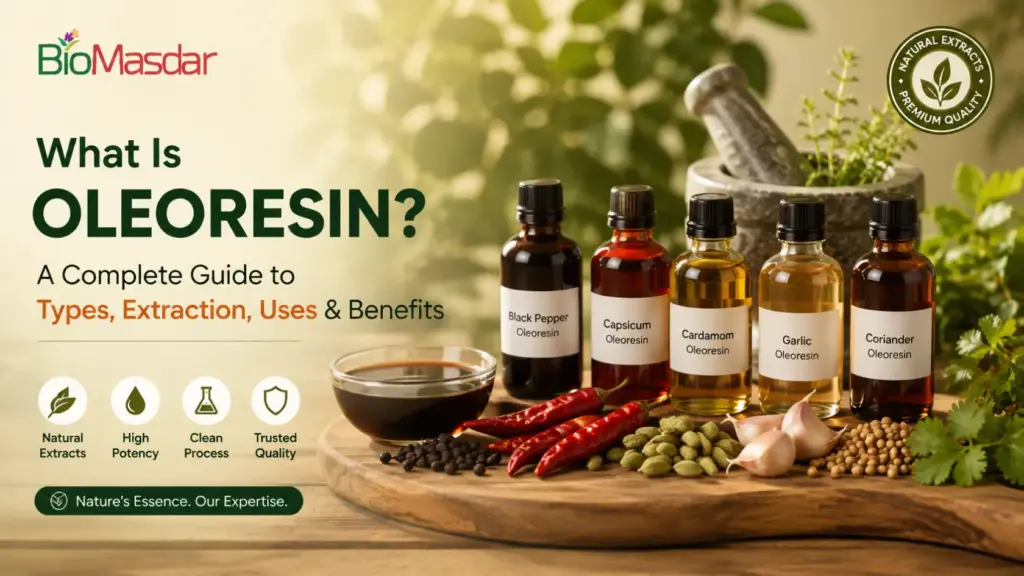
Oleoresin is a concentrated natural extract obtained from spices, herbs, or resinous plants that contains both the volatile essential oil and the non-volatile resin of the source material. This combination gives oleoresins the full flavor, aroma, and color profile of the original spice – but in a far more concentrated, stable, and easy-to-dose form. Oleoresins are widely used across the food, flavor, fragrance, nutraceutical, and cosmetic industries as natural alternatives to whole spices or synthetic additives.
At BioMasdar, oleoresins are extracted from locally sourced spices in Pakistan and supplied in bulk to manufacturers who need consistent flavor, aroma, and color in every batch.
What Is Oleoresin?
Oleoresin (from oleo = oil + resin) is a semi-solid or viscous liquid extract that captures the complete flavor, aroma, and pigment profile of a spice, herb, or plant. Unlike an essential oil, which contains only the volatile aromatic compounds, an oleoresin retains both the volatile oil fraction (responsible for aroma) and the non-volatile resinous fraction (responsible for taste, pungency, and color).
In simple terms: if you extracted every flavor-and-color compound from a spice like black pepper or capsicum and concentrated it into one product, you would get an oleoresin. It is, in effect, “the spice in its most concentrated natural form.”
Oleoresins are classified as natural extracts and are widely accepted in the food industry as clean-label alternatives to synthetic flavorings and colorants.
What Is Oleoresin Made Of?
Every oleoresin is made up of two main components:
- Volatile essential oil fraction – contributes aroma and top notes
- Non-volatile resin fraction – contributes taste, pungency, mouthfeel, and natural pigments (such as capsaicin in capsicum oleoresin or piperine in black pepper oleoresin)
Because oleoresins contain the resin fraction, they are typically far more concentrated than essential oils alone – often described as being 10 to 20 times stronger than the equivalent weight of the raw ground spice.
How Is Oleoresin Extracted?
Oleoresins are commercially produced using solvent extraction, a controlled industrial process:
- Raw material selection – High-quality, cleaned, and dried spices (whole or crushed) are selected as the starting material.
- Solvent extraction – The spice is treated with a food-grade solvent (commonly ethanol, hexane, acetone, or ethyl acetate) that dissolves the flavor, aroma, and color compounds out of the plant matrix.
- Filtration – The resulting miscella (solvent + extracted compounds) is filtered to remove plant residue.
- Solvent recovery – The solvent is evaporated and recovered under vacuum and controlled temperature, leaving behind the concentrated oleoresin.
- Standardization & quality testing – The final oleoresin is tested and standardized for color value, pungency, volatile oil content, and microbiological safety before packaging.
Some producers also use CO2 (supercritical) extraction, which avoids residual solvent traces entirely and is often preferred for premium or “clean label” applications.
Oleoresin vs. Essential Oil: What’s the Difference?
This is one of the most common points of confusion, so here is a direct comparison:
| Feature | Oleoresin | Essential Oil |
| Extraction method | Solvent or CO2 extraction | Steam distillation or cold pressing |
| Composition | Volatile oil + non-volatile resin | Volatile aromatic compounds only |
| Flavor/taste | Full flavor, pungency, and color | Mostly aroma, little to no pungency/color |
| Concentration | Very high (whole flavor profile) | High (aroma only) |
| Common use | Food flavoring, seasoning, color | Fragrance, aromatherapy, flavoring |
| Physical form | Viscous, semi-solid, sticky | Thin, free-flowing liquid |
In short: an essential oil smells like the spice, while an oleoresin tastes and looks like the spice too, because it carries the color and pungency compounds that distillation leaves behind.
Types of Oleoresins
Different spices yield oleoresins with distinct flavor, color, and pungency profiles. Some of the most commercially important oleoresins include:
Black Pepper Oleoresin
Extracted from premium black pepper, this oleoresin delivers the characteristic sharp pungency (from piperine) and warm aroma of black pepper in concentrated liquid or semi-solid form. It is widely used in processed meats, sauces, seasoning blends, and snack coatings where consistent heat and depth are required batch after batch.
Capsicum Oleoresin
Derived from chili peppers, capsicum oleoresin is prized for its standardized pungency (measured in Scoville Heat Units) driven by capsaicin content. It’s used in spicy snack seasonings, sauces, ready meals, and even non-food applications like pepper sprays and topical warming products.
Cardamom Oleoresin
Extracted from green cardamom pods, this oleoresin captures the sweet, aromatic, slightly camphoraceous character that defines cardamom. It’s popular in bakery, confectionery, beverages, and premium spice blends where a strong, authentic aroma matters.
Garlic Oleoresin
A concentrated extract of fresh garlic, delivering pungent, savory flavor without the moisture, bulk, or short shelf life of fresh or dehydrated garlic. Commonly used in sauces, marinades, seasoning blends, and savory snack flavoring.
Coriander Oleoresin
Extracted from coriander seed, this oleoresin offers the citrusy, slightly sweet, earthy flavor notes used in curry powders, spice blends, sausages, and pickling formulations.
Browse the full range on the Oleoresins category page at BioMasdar.
Key Properties of Oleoresins
- Highly concentrated – small dosage replaces large quantities of raw spice
- Standardized strength – consistent pungency, color, and flavor across every batch
- Long shelf life – more stable than whole or ground spices, with reduced risk of microbial contamination
- Space and cost efficient – lower storage volume and transport cost per unit of flavoring power
- Free from botanical impurities – no husk, fiber, seed, or foreign matter, unlike ground spice
- Uniform dispersion – blends evenly into liquid and dry formulations
Industrial Uses & Applications
Oleoresins are used across multiple industries because of their concentrated, standardized nature:
- Food & Beverage – seasonings, sauces, snack coatings, ready-to-eat meals, marinades, soups, processed meats
- Spice Blending – used to standardize pungency and color across large production batches of masalas, curry powders, and seasoning mixes
- Nutraceuticals & Supplements – capsule and tablet formulations using standardized actives (e.g., piperine, capsaicin)
- Cosmetics & Personal Care – natural colorants and active ingredients in topical formulations
- Pharmaceuticals – some oleoresins are used for their bioactive compound content
- Pet Food & Animal Feed – flavor enhancement and palatability agents
Benefits of Using Oleoresins
- Consistency – manufacturers get the exact same flavor and color strength in every shipment, unlike natural spice crops that vary by harvest and season.
- Extended shelf life – oleoresins resist oxidation and microbial spoilage better than raw or ground spices.
- Cost efficiency at scale – less product is needed per batch, and lower storage/transport volume reduces logistics costs.
- Clean-label appeal – as a natural extract, oleoresin fits “natural flavoring” and “natural colorant” labeling requirements better than synthetic alternatives.
- Precision dosing – standardized potency (e.g., a defined pungency or color value) allows accurate, repeatable formulation.
- Reduced contamination risk – free of insect fragments, dirt, and other physical contaminants sometimes found in whole spices.
How to Choose a Quality Oleoresin Supplier
When sourcing oleoresins in bulk for industrial or commercial use, look for a supplier that offers:
- Standardized specifications – documented pungency, color value (ASTA units), and volatile oil content for each batch
- Traceable raw material sourcing – clear origin and quality control of the source spice
- Food safety certifications – Halal, HACCP, ISO, or equivalent food safety compliance
- Consistent export-quality supply – reliable bulk quantities without batch-to-batch variation
- Technical support – guidance on dosage, application, and formulation compatibility
BioMasdar, based in Karachi, Pakistan, supplies bulk oleoresins – including black pepper, capsicum, cardamom, garlic, and coriander oleoresin – to food, flavor, fragrance, pharma, and cosmetic manufacturers, backed by export-quality processing and reliable sourcing from local raw materials
Your Questions, Answered
Q1. What is oleoresin used for?
Oleoresin is used to add concentrated flavor, aroma, pungency, and natural color to food products, seasonings, sauces, nutraceuticals, cosmetics, and pharmaceuticals. It replaces whole or ground spices where consistency, shelf life, and dosing precision matter.
Q2. Is oleoresin natural or synthetic?
Oleoresin is a natural extract. It is obtained directly from spices or plants through solvent or CO2 extraction, with no synthetic flavor or color compounds added, making it suitable for natural and clean-label product formulations.
Q3. Is oleoresin the same as essential oil?
No. Essential oil contains only the volatile aromatic compounds obtained through steam distillation, while oleoresin contains both the volatile oil and the non-volatile resin, giving it the spice’s full flavor, pungency, and color – not just its aroma.
Q4. Is oleoresin safe to consume?
Yes, food-grade oleoresins that meet regulatory purity and residual-solvent standards are considered safe for consumption and are widely approved for use as natural flavoring and coloring agents in the food industry.
Q5. How is oleoresin different from ground spice?
Oleoresin is a concentrated liquid or semi-solid extract with standardized potency and no physical spice particles, while ground spice is the whole dried plant material ground into powder, with variable strength and a shorter, less stable shelf life.
Q6. What is capsicum oleoresin used for?
Capsicum oleoresin is used to add standardized heat (pungency) to spicy foods, sauces, and snack seasonings, and is also used in non-food applications such as pepper sprays and topical warming formulations.
Q7. Where can I buy bulk oleoresin in Pakistan?
Bulk oleoresins – including black pepper, capsicum, cardamom, garlic, and coriander oleoresin – can be sourced from BioMasdar, a Pakistan-based supplier offering export-quality natural extracts for food, pharma, nutraceutical, and cosmetic manufacturers.
Q8. How should oleoresin be stored?
Oleoresins should be stored in tightly sealed, airtight containers away from direct light, heat, and moisture, ideally in a cool, dry environment, to preserve their flavor strength, color, and shelf stability.
Let’s Wrap Up
Oleoresin bridges the gap between raw spice and industrial-grade flavoring: it delivers the complete taste, aroma, and color of a spice in a concentrated, consistent, and shelf-stable form that ground spices simply can’t match. Whether you’re formulating spicy snacks with capsicum oleoresin, standardizing pungency with black pepper oleoresin, or building a natural clean-label seasoning blend, understanding what oleoresin is – and how it’s made – is the first step to using it effectively.
Ready to source bulk oleoresins for your production line?
BioMasdar supplies export-quality black pepper, capsicum, cardamom, garlic, and coriander oleoresins to food, flavor, pharma, and cosmetic manufacturers worldwide. Explore BioMasdar’s Oleoresin Range or Contact Us to request a quote and product specification sheet.